The tribunal fixed what Ratko Mladić did. This week Serbia's protocols named what it intends to keep.
By Kadri Kryeziu, Publisher | 28 August 2026
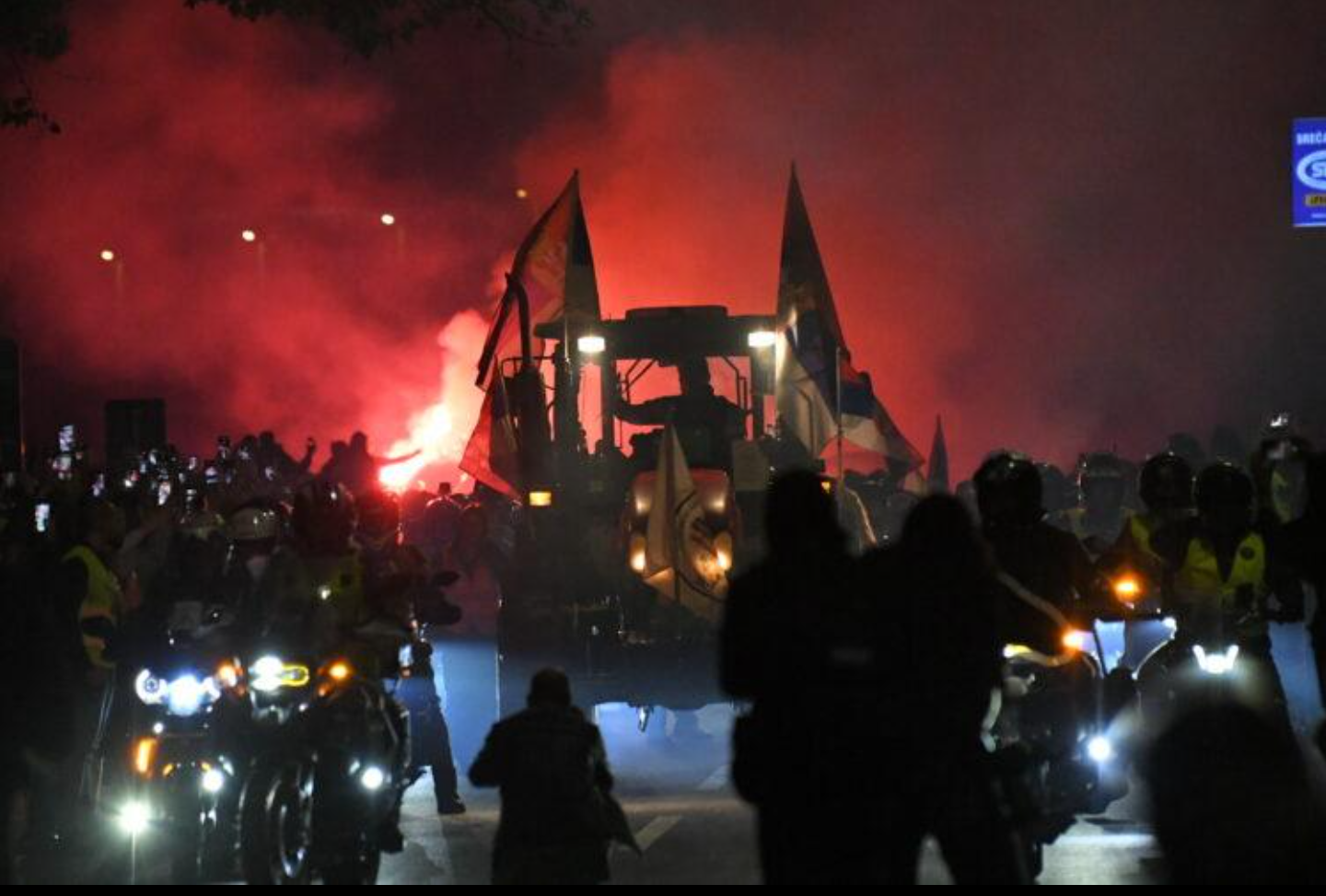
Within a day of the Hague Mechanism confirming that Ratko Mladić had died in its detention unit, Serbia's justice minister appeared on Republika Srpska's ATV to answer the only question Belgrade treated as open. Not whether the state would honor him. How. "General Mladić je general i znaju se protokoli. Zna se i njegova uloga, ali ono što pripada generalu Mladiću, to će sigurno biti ispoštovano," Nenad Vujić said. General Mladić is a general and the protocols are known. His role is known too, but what belongs to General Mladić will certainly be respected. The ministry stood ready to travel to The Hague the following morning to collect the body. The family would choose the grave. By the time he spoke, churches across Republika Srpska had opened for candles and torches were burning on the bridges of Belgrade and Novi Sad.
The honors were never in question.
The word carrying the whole document is ali. But. Vujić conceded the record in the same breath that he awarded the honors: the role is known too. There is no denial in the sentence and no appeal in it. The tribunal convicted Ratko Mladić and fixed his acts permanently in the record, genocide, crimes against humanity and war crimes, among them extermination, persecution and the terror campaign against Sarajevo's civilians. Vujić contests none of it. He files the rank in a different drawer, one the tribunal never held a key to. The law records a génocidaire. The protocol records a general. Both records survived Thursday, and Serbia has told us which one governs the burial.
It is worth stating plainly what kind of general is being buried. A defeated one. The project he commanded failed. Bosnia survived. Sarajevo survived. Srebrenica became the name by which the world remembers him. He spent years in hiding, the early ones living quietly in Belgrade itself, and in May 2011 Serbian officers arrested him in a village north of the capital. A Serbian government flew him to the Netherlands, and its justice minister, Snežana Malović, called the handover the fulfillment of Serbia's "international and moral obligation." Fifteen years later the same ministry announces that it stands ready to bring the body home under the highest honors of the state. The extradition surrendered the man. Thursday's statement recovered the rank.
That recovery is the document, and it should be read for what it says about categories rather than verdicts. Every state decides what part of a defeated past belongs to history and what part belongs to inheritance. Protocol is continuity. Vujić's sentence means that nothing had to be invented for this uncomfortable coffin. Thirty years after the war, the rank still carried a claim on the Republic. When Kosovo's courts arrest Serbian suspects on war crimes charges, the same state reaches for teror and progon, terror and persecution. A Republic that proved it could physically surrender its general has spent the fifteen years since declining to surrender the vocabulary that produced him.
The vocabulary has an author with a long publication history. In 1997 he told a German interviewer that Serbs, too, "will be patient in order to regain our land." Between that sentence and this coffin lie the 1999 war, the fall of Milošević, Kosovo's independence, Montenegro's departure, the arrest in Lazarevo, the life sentence, EU candidacy, and a red carpet in Belgrade for Ukraine's president, who pronounced Serbia ready to move toward Europe. On 10 August of this year the same man, now Serbia's head of state, gave the mature edition: slowly, things in the world are changing, nothing moves simply or certainly, but changes in the world order will come, "and let us see whether we can have more freedom or less freedom in our own actions in the future." Eight days later, asked about a bridge over the Ibër (Ibar), he reported on the tempo: the world is changing, but not as fast as had been hoped. Twenty nine years separate the sentences and the grammar has not moved.
Waiting is a policy every small state knows. What has changed is the equipment. Serbia's president says the army will soon field forty fighter jets. A combat drone factory, majority owned by Israel's Elbit Systems, was announced from the podium he shared with his Ukrainian guest, with an opening announced for September. In June he confirmed the purchase of Chinese HQ-9 air defense systems, and in August his defense minister convened the second session of a standing defense subcommittee with Beijing. The Stockholm ledger has Serbian military expenditure climbing from 1.7 billion dollars in 2022 to 2.3 billion in 2024, and the 2026 budget carries the funds to bring back mandatory military service over the next three years. A political tradition organized around unfinished history reads differently when the waiting is accompanied by accumulating military power. None of this schedules a war. The waiting, though, is no longer empty handed.
Europe has read a document like this before. After 1918, Germany filed its defeated army under inheritance rather than history. The verdict of the war was recast as an injustice done to the nation, and the army's honor was preserved in ceremony and memory long before it reappeared in a budget line, while the powers that could have read the protocols preferred the more comfortable file. We will state the disanalogies ourselves. Nothing in this piece nominates Aleksandar Vučić as a small Hitler or casts Serbia as a rehearsal of 1938. Serbia is a small state, the European Union is no Versailles, and history does not restage itself on demand. The analogy stops there. The mechanism keeps going, and it needs no timetable. It needs defeat to stay morally unsettled: the lost cause keeping its honor, the settlement remaining an injury that greater freedom of action might one day correct. What Germany demonstrated is narrower and worse than prophecy: a society can be made ready to receive a second act of the last war as restitution long before anyone decides whether, or when, to stage it. The readiness does not require consensus. A state can leave its people unpersuaded so long as the category stays legitimate, and the candles in the churches and the torches on the bridges are the upkeep.
Ratko Mladić lost his war and then his freedom. His appeals failed. He died in the prison of the court that fixed his crimes permanently in the record, and there is almost nothing left for Serbia to give him. The salute and the word general confer the one thing the judgment could not confiscate: continuity. The funeral, when it comes, will show what the Republic is burying, the project or only the man who carried it. Vujić answered before anyone asked. He was given a question about a coffin. He described an inheritance.
