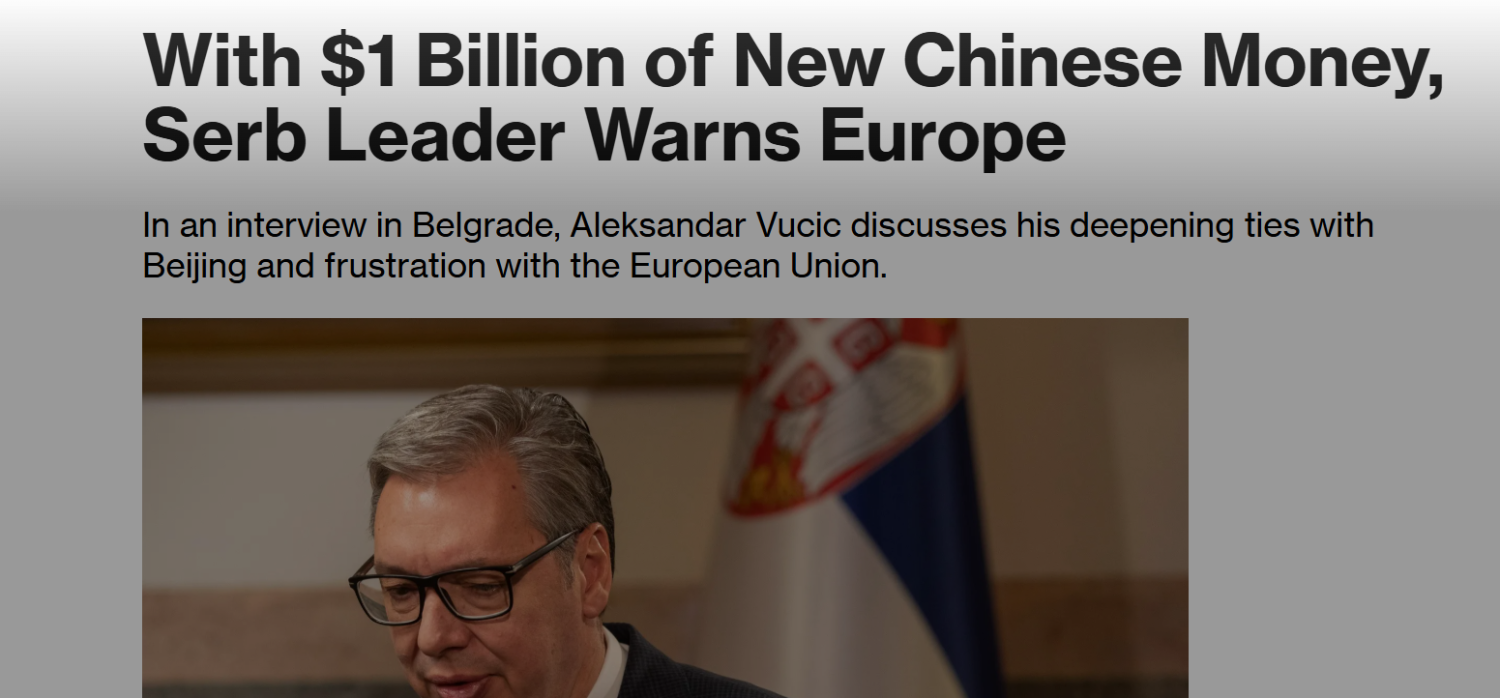
Aleksandar Vučić told Bloomberg that Europe is asleep, complacent, blind to what moves around it. He had just flown home from Beijing with another billion. The provocation was not the insult. It was that three European capitals had spent two years proving him right.
by Klea Ukaj | 2 June 2026
Read the interview as a signal, not a tantrum.
Vučić sat down with Bloomberg this week fresh from Beijing, another billion dollars in Chinese pledges in hand, and called Europe a continent asleep: complacent, slow, blind to what moves around it. Protectionism, he said, is killing Europe. He will pursue EU membership, naturally, but he cannot wait forever, and in the meantime he must look after himself.
In Pristina the reflex is to hear bravado. Hear it instead as a field report. Vučić is describing, with some precision, a Europe he has spent two years reading from the inside. What he read, Europe taught him.
Return to the summer of 2024.
In July, Olaf Scholz flew to Belgrade and signed a strategic partnership on lithium and batteries, three days after Serbia revived the Jadar permit on the strength of a court ruling loyal to the government. The stated aim was to cut Europe's dependence on China. The room was full of German carmakers. Brussels sent a vice president to bless it. That same year, Serbia's free trade agreement with China came into force.
In August, Emmanuel Macron flew to the same city and sold Vučić twelve Rafale jets for €2.7 billion, much of it on French bank loans. He called it a demonstration of European spirit. In the same breath he warned that Serbia's balancing act between the powers was an illusion.
Two years on, the balancing act has French jets on order, Chinese billions in the ground and an American energy package under discussion. The only illusion was the one Paris sold itself at the signing table.
This is usually mistaken for cunning. It is not. Vučić did not outmanoeuvre a united Europe. There was no united Europe to outmanoeuvre. Berlin bid for his lithium. Paris bid for his defence budget. Brussels bid for the credibility of its own enlargement file. Each bid cancelled the single condition all three claim to impose. He lives inside his contradictions at no cost because the people sent to collect the rent kept arriving with gifts.
Now the part Pristina knows in its body.
While Belgrade was courted with raw materials partnerships and fighter jets, Kosovo spent two and a half years under EU measures. Funds frozen, engagement suspended, the whole apparatus triggered by a dispute over four mayors in the north and the temperature of a transfer of local power. The measures came in June 2023. They were lifted only this winter, once the handover in the north was judged peaceful enough.
Hold the two files side by side and the Union's revealed preference is plain. Belgrade offered lithium, a defence market and the theatre of a candidacy it has no intention of completing, and was rewarded for all three. Pristina offered compliance. Compliance is the one currency Brussels does not pay for.
So when Vučić calls Europe asleep, the error is not in the adjective. He is the man who walked through the sleeping house and emptied the drawers, and the household has just invited him to describe the experience to Bloomberg. He did. In English. For the wire.
Klea Ukaj writes from Michigan and contributes to The Kosovo Dispatch’s trans-Atlantic coverage.
