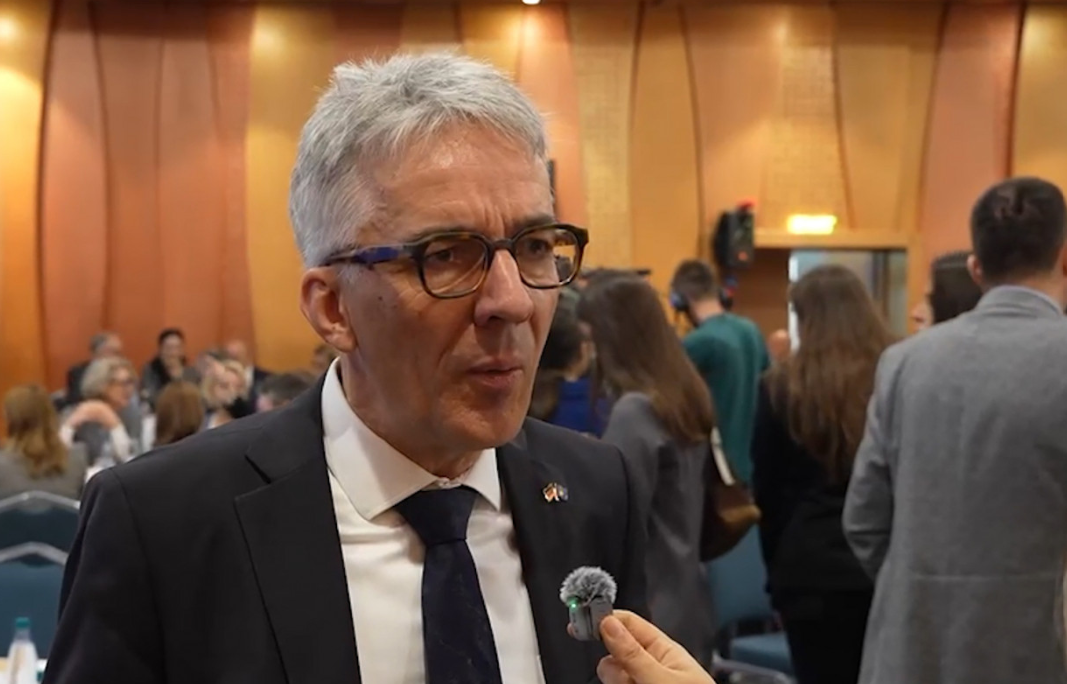
Berlin asks Kosovo for steps on the Association. The side that refuses to acknowledge the 2023 agreement is the other one.
The Editorial Board | 24 October 2026
The German ambassador in Pristina told Ekonomia Online this week that Kosovo should implement “the agreement on the creation of a form of self-organisation for the Serb minority.” He said both countries have much work to do, that the EU is not exerting pressure, and that the reasons for years of delay are not worth discussing. Two days earlier, in Budva, six Western Balkan leaders sat with Chancellor Merz. Only one of them came away with a photograph of a bilateral to post: the Prime Minister of Kosovo, whom Merz congratulated on his new mandate. It went out from Pristina the same afternoon. The Austrian Chancellor’s only bilateral post from Budva was with Kurti as well.
If anyone in Berlin believes the Association can be carried home on photographs and a friendly interview, they are wrong, and not for the reason they suppose.
On 27 February 2023, in Brussels, Kurti and Vučić accepted the Agreement on the Path to Normalisation. Kosovo was ready to sign. Serbia was not, and Borrell declared the text adopted by his own statement. On 18 March, in Ohrid, the two accepted the Implementation Annex. Kosovo undertook to begin negotiations immediately on self-management for the Serb community. Serbia again declined to sign. On 26 October, with Macron, Scholz and Meloni in the room, Kurti accepted the European draft statute for the Association in principle, and the European Council recorded that acceptance in December. That same month the Serbian government sent Brussels a letter stating that its commitment to the agreement does not extend to Kosovo’s membership in the United Nations or to Kosovo’s territorial integrity. That is the sequence the ambassador says is not worth discussing.
Three steps, in the order Brussels set them. Kosovo took each one. Serbia declined to sign the first two and wrote a disclaimer on the third.
Since then Kurti has named his conditions for moving on the Association: Serbia’s signature on what it agreed, the withdrawal of that letter, and the handover of Milan Radoičić. In May he said the Association had been superseded by the integration of Serb health and education into Kosovo’s system, and Brussels disagreed the next day. Argue with his sequencing if you like. Every condition he has named is Belgrade’s to meet, and Belgrade has met none.
So the problem is not in Pristina.
On 16 October Ivica Dačić, Serbia’s Interior Minister and First Deputy Prime Minister, gave RT Balkan an interview in Moscow. Kosovo’s membership in international organisations, which Serbia undertook not to oppose in Article 4 of the 2023 Agreement, is “completely unacceptable.” Everything else in the agreements waits on the Association: someone who has not formed it, he said, is invoking what is only the next step. He will go on collecting withdrawn recognitions. Brussels wants sanctions on Russia and recognition of Kosovo, and if Serbia did those two things “tomorrow we would become the greatest democrats.” Serbia will do neither.
On 20 October Russia’s ambassador repeated it at the Security Council: the oral agreements of 2023 are being pressed, the binding Brussels agreements forgotten.
On 21 October Aleksandar Vučić, on election-eve television, settled who signed what. “That agreement was signed by Dačić. They never attacked him, they always attacked me. And I have no problem with that. I refused to sign.”
This is the state that does not acknowledge the 2023 agreement. Its minister flew to Moscow to say so nine days before an election. Its president said so on television three days before the German ambassador’s interview appeared. “Both countries,” on the record of this one week, means one country refusing in three capitals and another that took every step it was asked to take, named its conditions, and waits.
This publication supported Ambassador Rudolph on 16 September, when he said what Berlin thought about the Specialist Chambers and said it plainly. We hold him to the same standard. He also said the EU owes Kosovo the forwarding of its membership application to the Commission, where it has sat since December 2022. Berlin could start there. Then it could put the question about the Association to the man who refused to sign, and to the minister who went to Moscow to explain why. The photograph was taken in the wrong room.