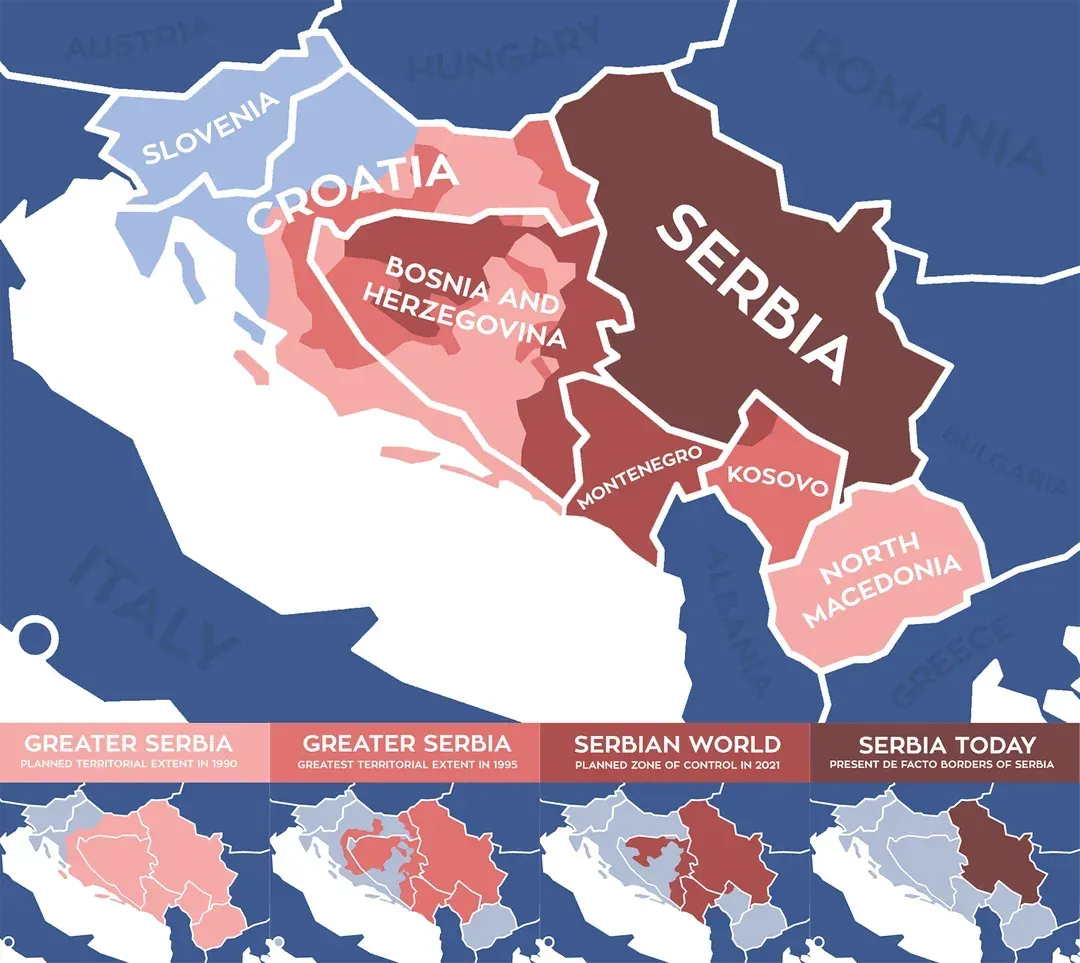
Zukan Helez asked the only question a host state can ask about armed men on its soil. The answers came back in rivers and ancestral land. Serbia's other neighbours should learn the question by heart.
By Drizan Shala | 6 August 2026
On 3 August the special unit of the Central Bosnia Canton interior ministry went looking for a group of armed men in civilian clothes near Čipuljići, the village outside Bugojno where Serbia's president was visiting his father's family house. The cantonal police record describes roughly thirty members of Republika Srpska's Special Anti-Terrorist Unit carrying long-barreled weapons, in civilian clothes without police insignia. They moved in vans and on quads, in vehicles registered to private persons. Asked by the officers securing the area what they were doing there, they answered: reconnaissance. When the special unit moved in to check them they fled the wooded area, and they were ordered out of the canton at its boundary with Canton 10. Čipuljići lies in the Federation of Bosnia and Herzegovina, in a canton where neither Serbia's services nor those of Republika Srpska hold any police competence.
Bosnia's defense minister, Zukan Helez, congratulated the cantonal police and drew the conclusion. Vučić, he wrote, had learned that the Drina is a border after all: "Vučić je naučio da je Drina ipak granica." We will state our position plainly. On the substance, Helez was right, and saying so costs nothing while conceding the messenger. The minister is a blunt instrument and his record includes claims that did not survive scrutiny. The question survives him. A state that finds armed men on its territory, absent from every registered list, is entitled to their names and to the authority under which they carried weapons, in Travnik or in Tallinn.
The answers came within a day, and none of them concerned registration.
Serbia's president said the men on quads belonged to the Republika Srpska interior ministry, that the men at the house were members of its special anti-terrorist unit, that not one man came from Serbia, and asked why Helez does not arrest him. The cantonal record identifies the same unit, which settles who the men were and leaves standing only the question of what authority they carried. A state secretary in Serbia's government, Adam Šukalo, whose own statement located the president's itinerary in Republika Srpska and in parts of the Federation, answered that for Serbs the Drina is not a border but a river joining "jedan srpski i nedeljiv narod", one indivisible Serbian people. Then Serbia's defense minister, Bratislav Gašić, in writing from Mrkonjić Grad: the Drina is not the border of the Serbian people, nor will it ever be. "Drina nije granica srpskog naroda, niti će to ikada biti." The president, his statement continued, comes to no one else's house but his own dedovina, his ancestral land, among his own people.
Read the exchange the way an analyst reads an intercept, for what each side believes it is answering. Helez asked about the state. Belgrade answered about the nation. The list of names, the one document a functioning protocol could produce within an hour, has been produced by no one.
Take Serbia's president at his word. Assume every man carried a Republika Srpska service card and every weapon was licensed in Banja Luka. The problem does not shrink. It changes uniform. Special-unit personnel out of uniform, in privately registered vehicles, describing their own activity as reconnaissance, are the opposite of a declared escort. And under Bosnia's police architecture, only four bodies hold standing police powers on a Federation canton's territory beyond the cantonal police themselves: the state Directorate for Coordination of Police Bodies, SIPA, the Border Police and the Federation Police Administration. The Republika Srpska interior ministry is not among them; its officers may perform defined tasks in a canton only under conditions the cantonal police agree in advance. The alibi contains the allegation.
The vocabulary that answered Helez has a file of its own. Srpski svet, the Serbian world, entered official language in 2020 through Aleksandar Vulin, its first public user, who carried it from the defense ministry to the interior ministry, where it sits on the ministry's website as doctrine, and then into the Security Information Agency, which he directed until a resignation statement citing pressure on Serbia and the Serbian world. The template is Moscow's russkij mir, and the load-bearing feature carried over intact: the claim is always entered for the nation, never for the state. Narod, not država. A nation has no borders to redraw, so every spokesman can certify that no territorial demand was made. Programs defining the Serbian nation as one political body across the borders of neighboring states are not new in this region. The older ones did not need a euphemism.
Who spoke matters more than what was said. Gašić has run Serbia's intelligence agency, then its police. Now he runs its army. A defense minister's written statement is an instrument of state, whatever register it borrows, and this one, addressed to a neighboring state's defense minister, asserts that the nation's geography runs across that state's territory and always will. The words the Charter uses for what such a claim presses against are sovereign equality and territorial integrity. The week had already built the sentence its context. Days earlier at Janjila, Serbia's president measured his army against the JNA and found it stronger by multiples. At Mrkonjić Grad he pledged that Serbia will protect its people and will not wait or look for an excuse. The same day, the minister commanding that army removed the western border from the people the pledge covers.
Bosnia should not treat this as a first encounter. The question was asked once before, in nearly identical form, and the file on how Belgrade answers it is complete. On 24 September 2023 roughly thirty armed men in military equipment occupied the Banjska monastery area in northern Kosovo and killed a Kosovo police sergeant. Serbia's leadership denied state involvement. Weeks later Milan Radoičić, then vice-president of the Belgrade-backed Srpska Lista, admitted through his lawyer that he had organized and equipped the group. Serbia declared a day of mourning for the attackers killed. It has extradited no one. The sequence deserves to be read slowly. Armed men. Denial. Admission by the organizer. Honors for the dead. No names surrendered, no men handed over, no consequence borne. Čipuljići has produced, so far, the opening moves of the same game.
The construction is portable, and the neighbours should notice. Roughly a third of Montenegro's citizens identify as Serbs. In the same week, reacting to Montenegro's government sending a representative to the Knin celebration of Operation Storm, Serbia's president thanked by name the Montenegrin Serb politicians who came to Mrkonjić Grad instead, declared that Serbia will not renounce its kin for the sake of a European future, and asked Montenegro's citizens, Serbs especially, to watch who acts in the interest of their people and who against it. A president sorting a neighbour's politicians by service to the nation, over the heads of the neighbour's government, is the doctrine in its retail form. Croatia hosts the grievance itself: Serbia now commemorates Operation Storm at state level and is raising a national memorial to its victims, a ritual that files a wound against a neighbour's territory into the state calendar. Wherever the census finds Serbs, the formula finds people to protect. A neighbour's census, read through this doctrine, becomes a map of claims.
What the neighbours should take from Bugojno is not alarm. The cantonal police received reports, deployed, located the men and escorted them out within the day. No shot was fired. The defense against a nation defined without borders turned out to be a state functioning within its own: a duty officer, a patrol, a list checked against reality. That is the model, and the prescription it yields is paperwork. Require the full security detail in writing before the visit, under the host state's law, and publish the request if it goes unanswered. Detain and name any armed man found outside the list, whatever service card he carries. And when the answer comes back in rivers and ancestral land, file it in the diplomatic record for what it is, a state's official reply to a jurisdictional question, and send it to Brussels and Washington still attached to the question it did not answer. To the objection that this treats every family visit as an operation: it was not the neighbours who attached thirty armed men to a private itinerary, and a president who travels with only the escorts he declares will never notice the regime we describe.
Whose men were they? On the unit, the two capitals now agree. On the names, and on the authority under which thirty armed men reconnoitered another entity's canton, the page is still blank. Helez said the Drina is a border after all. We would put it more carefully. The Drina is a border, and the doctrine that answered him does not believe in yours either. The question is already travelling. Podgorica and Zagreb should have it ready in writing, and Pristina has held it, unanswered, since Banjska.
Drizan Shala writes on security, institutions, and political violence for Kosovo Dispatch and Tirana Examiner. He is a doctoral candidate at the University of Sarajevo.