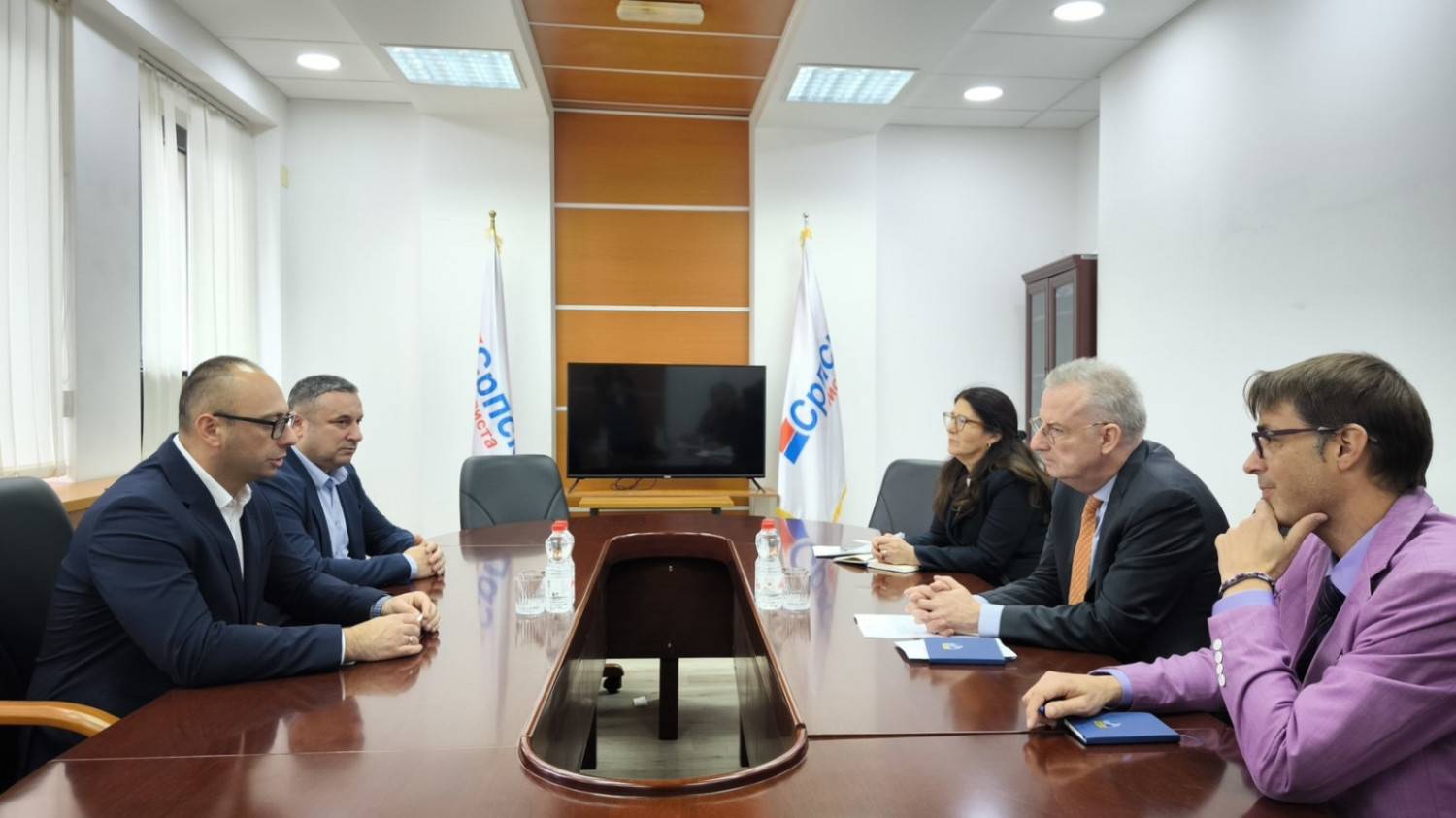
Belgrade’s method needs a photograph and its own text. On Monday Dirk Schuebel supplied the photograph.
Artan Rugova | 3 November 2026
Petrit Selimi, Kosovo’s former foreign minister, put three headlines side by side this week. Nova.rs, 2 August 2026: “Vučić: We are suffering horrific terror in Kosovo.” Analitika, 20 August 2026: Vučić writes to Rutte, asks KFOR to stop “terror against Serbs” and keep the Ibar bridge shut. RTV, 21 August 2022: “permanent terror against Serbs”. His caption: since Vučić now shouts that the Student List is committing terror against his party, which is verifiably untrue, Serbia might consider that the Kosovo version “was also verifiably untrue”.
On 29 October, four days after losing the election, Vučić told reporters at SNS headquarters that Serbia had lived through 72 hours of “naked, real revolutionary terror”. On 30 October, on Informer, the students “live for red terror”. His caucus in the new parliament is to be called “Serbia against terror”. The word he sent to NATO’s Secretary General about Kosovo in August was spent on his domestic opponents in a week, and nobody outside Serbia took it seriously.
Two days later his party in Kosovo carried the word to the EU ambassador in its diplomatic form. On Monday Igor Simić and Srđan Popović received Dirk Schuebel in the Srpska Lista caucus rooms at the Assembly. Their readout, carried by Tanjug: the party “expressed its conviction that the forthcoming European Commission report will pay particular attention to the difficult position of the Serb people” and to “the protection of the basic human, civil and political rights of Serbs”; the two sides had discussed “the European reform laws that the assembly in Pristina will debate in the coming period” and “the participation of representatives of the Serb people in decision-making”; and the meeting had underlined “the fact that the European Union recognises Srpska Lista as an important and constructive partner”. “Difficult position” is “terror” in the register the Commission can print. The report comes out on Wednesday. It was written long before Monday. Its caption in Serbia was written on Monday, with the ambassador in the room.
On 29 October Jugoslav Gašić of the Student List told Radio KIM that Srpska Lista “was the SNS’s contractor on the territory of Kosovo, with absolutely catastrophic results” and that the incoming government wants “no contact and no cooperation with them”. Nenad Rašić said the SNS might ask the party’s officials to resign. Ivan Vučković, an opposition councillor in Leposavić, said the party cannot function without Belgrade’s support. In six days Srpska Lista has met NATO’s Supreme Allied Commander Europe and the EU’s Special Representative, issued a communiqué after each, and in neither mentioned the election its patron lost. Monday’s readout is addressed to Gašić and to the directors of every Serbia-financed school and hospital in Kosovo who are deciding this week whom to fear: the patron is gone, the recognition is not. The ambassador’s meeting is the proof, and the Office’s silence is what makes it proof.
The EU Office’s readout of the same meeting has none of it. The ambassador “highlighted the vital role of political representation and active participation in the Kosovo Assembly in promoting and protecting community interests” and asked “for the Assembly to enable SL’s work in committees in accordance with the Constitution”. The Office wrote “community” and “Kosovo Assembly”. The party wrote “the Serb people” three times, “Serbs” twice, and “the assembly in Pristina”. Nothing in the Office’s text about partners, nothing about the report. At the time of writing it has not corrected a word of what was said in its name. This is how a European representative becomes an instrument of Serbian propaganda, and it has happened to this Office before: on 23 September Srpska Lista announced it had briefed Schuebel on “institutional pressure” and the Association while his Office announced a meeting with four northern mayors about municipal services. Belgrade’s method needs the photograph and its own text. The European supplies the photograph; the text is written for him unless he writes it himself.
The committees he wants opened were formed on 28 September. Every parliamentary group submitted its names except one; Speaker Albulena Haxhiu told the plenary that Srpska Lista “had still not submitted the names of its representatives”. The chair of the Communities Committee was left open for the party. No reason was given then or since. When the names finally came, the vote failed on 15 October and three times on 22 October, fourteen deputies taking part each time, eighty having voted minutes earlier on the RTK board. The Albanian parties are refusing and should say so rather than count a quorum. Srpska Lista, Radio KIM noted that day, “has so far not spoken publicly on the matter”. The complaint was made for it by the Kosovo Democratic Institute, a Kosovo Albanian NGO, then by the Assembly Presidency, then on Monday by the European Union. The party whose seats were at stake has not spoken once.
Article 78 gives the deputies holding the Serb-reserved seats a third of the Communities Committee. The right belongs to the seats. Srpska Lista holds nine of the ten and left them empty on the day the committees were built; an Assembly cannot be in breach for a vacancy the holder made. The rest is politics, a majority declining to vote for a party it does not trust, and nothing in what Schuebel said touches it.
On Wednesday Marta Kos presents the Enlargement Package. Belgrade’s media will quote the Kosovo report’s community chapter under Monday’s caption, and the caption will read as if it came from the ambassador, because he was in the room and said nothing after. Does the European Union recognise Srpska Lista as a partner, yes or no? Did the Office know how the party would describe the meeting? What did the ambassador say to Simić about 28 September?
Vučić used the same word for Kosovo and for the students, and it broke in his hands last week. Srpska Lista translated it, handed it to Brussels, and told Belgrade’s new government that Brussels accepted it. The ambassador is not yet the instrument; he is the man who has not said no. He has a day.