Serbia cut no Russian diplomats after 2022. Moscow’s regional presence grew instead, while documented operations kept leading back to Belgrade.
Ngadhnjim Brovina | 27 September 2026
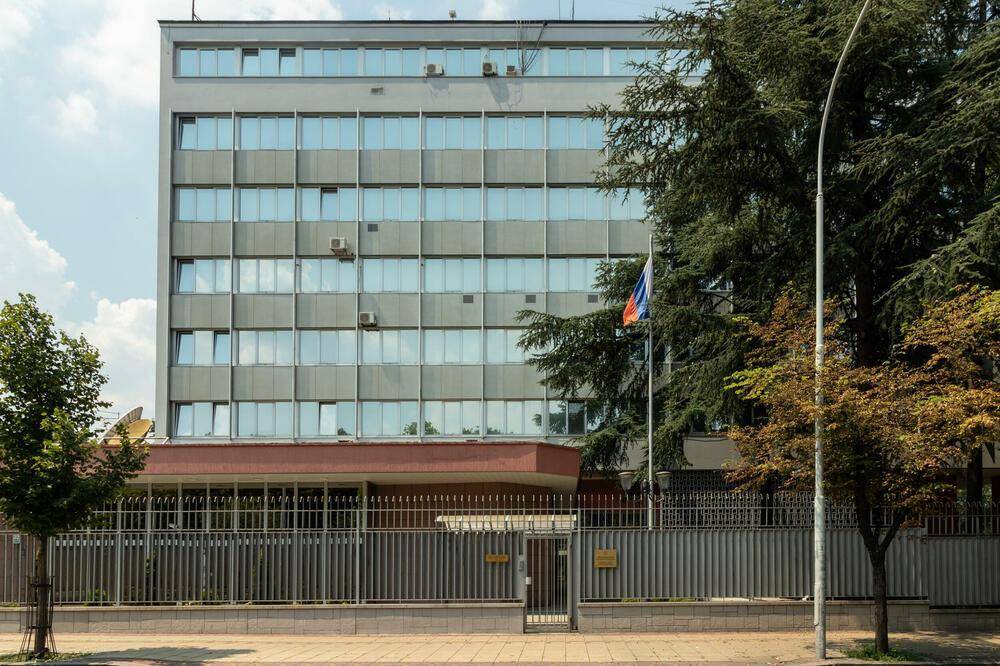
Aleksei Ivanenko was expelled from Zagreb in April 2022 as a second secretary and was on the Serbian diplomatic list by October as a first secretary. Radio Free Europe traced him to military unit 71330, the FSB's 16th Center, whose officers the US indicted in 2022 for breaking into energy networks. He is still in Belgrade on the list dated 14 September 2026. He is one of 29 names, out of 78 staff at the Russian embassy and trade mission, that Agentstvo placed in or near the Russian services on 25 September from leaked address and payroll records: 19 in the GRU and defence-ministry column, six of them the military attaché's office itself, the rest FSB and SVR. Leaks are not a court record and Agentstvo says "linked or possibly linked". The count that needs no leak is Serbia's own. The Serbian ministry's lists give 54 Russian diplomats in February 2022, 62 in March 2023, 68 in February 2024, 78 now. Bulgaria, the same size, expelled 83 and lists 18. Tirana lists 16, Skopje 14, Podgorica four. Serbia has expelled no one.
An embassy that grows by 44 per cent while every neighbour's shrinks is not watching Serbia.
In December 2025, according to the New York Times, Putin told his intelligence chiefs and commanders at a closed meeting that the goal for 2026 was the collapse of NATO and the EU from within; officials from two countries described the meeting. The same report places Moldova at the centre of that effort, and one of its camps in western Serbia: set up by the Russians in the summer of 2025, with GRU-linked instructors, to train cadres for election interference. Moldova's police said on 22 September that the trainees had been taught in Serbia by representatives of Russian special services, and detained 74 people. Serbia's Interior Ministry arrested two Serbian citizens on 26 September for organising combat-tactical training near Loznica for 150 to 170 Moldovan and Romanian citizens between 16 July and 12 September. On 15 October, standing beside Ursula von der Leyen, Vučić said he could not claim it was a Russian service ("Ja ne mogu da tvrdim da je to ruska služba"), and that Serbia had established the presence of three Russian citizens at the Sunčana Reka camp. Nobody has shown the camp was run from the embassy on Deligradska. By Vučić's own account, an operation the Times places inside that effort ran on Serbian soil with Russians present.
In October 2016 the GRU tried to stop Montenegro's NATO accession with a coup on election day; the two Russian officers convicted in absentia had operated from Serbia. In 2017 a leak from Macedonian counter-intelligence, published by OCCRP, described a decade of Russian effort to keep Macedonia out of NATO and recorded that the SVR officers in Skopje answered to the residency in Belgrade. In July 2018 Greece expelled two Russian diplomats for working against the Prespa agreement that opened North Macedonia's door to the alliance. In March 2022, three weeks into the invasion, Russia's ambassador in Sarajevo, Igor Kalabukhov, said on Bosnian television that if Bosnia chose NATO, Russia would respond, and that Ukraine showed what to expect. And the Russian embassy's chancery in Pristina, staffed from the Belgrade roster under the UNMIK umbrella and never accredited by Kosovo, has since August 2025 been headed by Ilia Uvarov, whom RFE/RL found in March in the Molfar database of intelligence-linked Russians.
Montenegro's accession, Macedonia's accession, Bosnia's accession, Moldova's election, Kosovo's recognition: in every case on this page the Russian state was working to keep a country out of NATO or the EU, or to keep its status unsettled. In December 2021, two months before the tanks moved, the Kremlin published two draft treaties demanding that NATO admit no further members and pull back to its 1997 line. Ukraine was the answer to that demand at the line of contact. The Balkans are the answer behind it.
The second front has no trenches. It is four alliance members, Croatia, Montenegro, Albania and North Macedonia, arranged around one non-member hosting the region's largest Russian diplomatic establishment, and two unfinished states whose completion Russia has fought for a decade. All it requires is to stay open: enlargement kept reversible in Sarajevo, recognition kept incomplete in Pristina, elections kept contestable in Chișinău, and the alliance's own guarantee kept debatable, work Robert Fico did for it in Prešov this month with his "some Article 5", whether or not anyone in Moscow asked him to. At Kuršumlija in August Vučić said that things are changing in the world, but not fast enough. Put it next to the December order.
Belgrade's position is sovereignty. It accredits whom it likes, it is militarily neutral, and its EU candidacy does not oblige it to copy EU expulsions. As a position that holds. As an argument it fails on Serbia's own record. Nobody has shown Serbia running these operations. Serbia houses a regional residency to which documented operations repeatedly lead back, grew it while every neighbour cut theirs, and promoted the officers the neighbours expelled. When a Russian military attaché was filmed handing cash to a retired Serbian officer in 2019, he left with Peskov's regret and no expulsion. The deputy prime minister is a man the US Treasury sanctioned in 2023 for facilitating Russia's malign activities in Serbia and the region. That is what a platform is. Neutral is what its owner calls it.
The question reaches past Vučić. Zagreb, Skopje, Podgorica and Sofia each closed their own door in 2022. The corridor between them is open and it runs through Belgrade; the second front is what Moscow uses it for. An expulsion regime with a hole in the middle leaks. An enlargement policy that opens accession clusters for the capital hosting the hole is doing Moscow's rear the courtesy of not noticing it.
Ngadhnjim Brovina is a political scientist at the University for Business and Technology in Pristina, where his research addresses party systems, democratic consolidation, and transnational party organisation in postcommunist Europe.
