Serbia's new majority has brought the language of occupation and ethnic cleansing to the rostrum of parliament. While Belgrade talks like this there is no normalisation and no reconciliation, only a public being prepared for the next war.
By Ngadhnjim Brovina | 27 November 2026
Serbia took a step back on 25 November, and it took it from the rostrum of its new parliament.
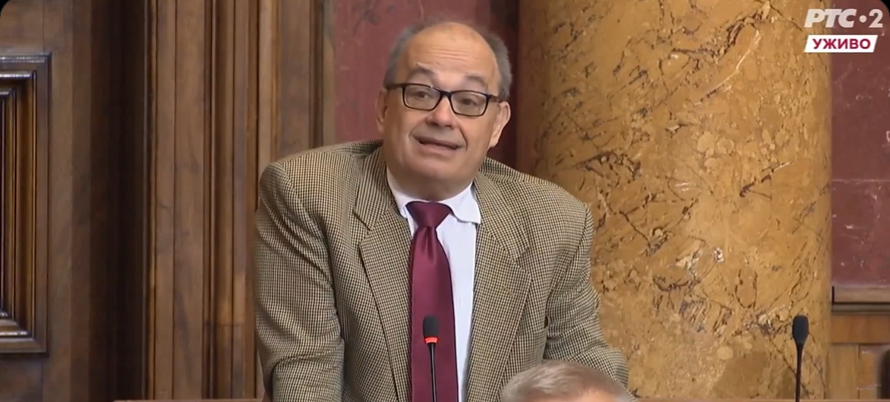
On the closing day of the National Assembly's constitutive session, in a debate on delegations to international parliamentary assemblies, a deputy of the majority Student List spoke about Kosovo. Slobodan Vukosavić is a full member of the Serbian Academy of Sciences and Arts. He called Kosovo "the temporarily occupied southern province". He said the number of Serbs there had fallen four times, called the fate of Serbs across the Balkans "de-Serbianisation", and said the people now in Kosovo's police and institutions are carrying out "something that has elements of ethnic cleansing". The day before, on television, it was "real ethnic cleansing", and those who had governed "wrapped in the national flag" were accomplices.
The word occupied was the list's campaign vocabulary before it reached the rostrum. Its candidate Radomir Saičić used it on the public broadcaster and reminded "false patriots" that the students had signed neither Brussels nor Washington and had not accepted the Franco-German plan. The Independent reported after the vote that the list rejects the earlier agreements with Prishtina. Aleksandar Vučić never declared an occupation, and he told parliament that "restoring sovereignty" over Kosovo meant a direct clash with NATO. On Kosovo the new majority stands to the right of the man it replaced.
The speech rewrites recent years as easily as distant ones. Vukosavić asked who had called Kosovo's Serbs out of their police uniforms. The call came from Belgrade's own party: the uniforms came off in Zveçan (Zvečan) on 5 November 2022, to applause, at a meeting of Srpska Lista, while Kosovo's prime minister publicly asked the officers to stay. In the speech the consequences of that walkout are charged to Kosovo as ethnic cleansing. He gave no source for the fourfold fall. Kosovo's census of 2024 counted 36,652 Serbs, and it was boycotted on a large scale in the four Serb-majority municipalities of the north. He said he had never heard those wrapped in the flag speak of ethnic cleansing. Vučić did so in July 2023, again from New York that September, and days later reported "brutal ethnic cleansing" to the Russian ambassador.
For thirteen years, whatever Belgrade said, a process existed: the Brussels Agreement of 2013, then the Agreement on the Path to Normalisation of February 2023 with its implementation annex of Ohrid, texts never formally signed and written into the European path of both Serbia and Kosovo. A process of normalisation has one premise, that two parties sit at the table. Occupation withdraws it. Nobody normalises relations with an occupier, and no Serbian official can be expected to implement agreements his own majority describes as complicity. As long as Belgrade talks like this, normalisation can be forgotten.
So can reconciliation. The count of Serbs in the academician's speech begins in June 1999. The reason an international force entered Kosovo that month, the expulsion of hundreds of thousands of Albanians by Yugoslav and Serbian forces, as the Hague tribunal established, does not appear. He told the chamber he trusted that no one present supports the ethnic cleansing of any people, "even if it is our own people". Two days earlier the student movement had rejected the European Parliament's draft resolution on the fall of Vukovar because it neglected the suffering of Serb civilians, and Vukosavić, asked about it on television, answered with the unprosecuted crimes of Operations Storm and Flash. In each case the wars of the 1990s have one victim. Reconciliation begins when a second is admitted.
The words do more than block a process. A province called occupied is one its owner is entitled to recover, and a population said to be undergoing ethnic cleansing is one somebody has a duty to rescue. The charge of complicity warns the next negotiator. The claim of a fourfold fall says time is running out. The literature calls this securitisation: an issue is lifted out of ordinary politics by being named a matter of survival, and measures that were unthinkable become arguable.
An occupation needs an occupier, and the list has never named one. NATO cannot serve. Its force entered Kosovo under Security Council Resolution 1244, which Russia voted for and Belgrade invokes to this day, and under a military agreement that Yugoslav generals signed at Kumanovo. That leaves Kosovo's own institutions, which is to say the people who live there, nine in ten of them Albanian. A country occupied by its inhabitants can be freed of the occupation in one way only, and Kosovo's Albanians saw it tried in the spring of 1999.
The region has heard this sequence. In 1986 the Memorandum of Vukosavić's Academy wrote of the "physical, political, legal, cultural genocide" of the Serb population of Kosovo. It was peacetime. Slobodan Milošević went to Fushë Kosovë (Kosovo Polje) the following April. At Gazimestan in 1989 he told a crowd that armed battles could not yet be excluded. The war came twelve years after the document. No one announced it in the meantime. It was explained, by academicians, deputies and editors, until force looked like a reply.
No order has been given in Belgrade and no plan is on the record. The list's candidates speak of "reintegrating" Kosovo peacefully, through diplomacy and dialogue. There is nothing to reintegrate. Kosovo is a state, and its citizens have not asked to be returned to anyone. A reintegration that the people concerned refuse has no peaceful form, and the word peacefully does not supply one. What is on the record is a vocabulary, spoken by a majority deputy at the first sitting of a new parliament. It is the mental preparation for the next war.
Ngadhnjim Brovina teaches political science at UBT in Prishtina. He writes on enlargement, conditionality, and the institutional politics of the Western Balkans.