Nine arrests in Zubin Potok drew four statements from Belgrade. None of them mentioned the mass grave the arrests concern.
By Fatos Kabashi | 27 September 2026
At six o'clock this morning, Kosovo Police entered five villages in Zubin Potok and took nine men into custody. By noon, four institutions in Belgrade and North Mitrovica had told the world what it meant. None of the four said which crime the arrests concerned.
On 19 April 1999, a group of Albanian civilians from Mitrovica and Skenderaj was taken from their homes. They were doctors, professors, lawyers, activists. Kosovo has called them the "group of intellectuals" for twenty-seven years and has carried them on its missing persons list as twenty-three names. Their families have spent those years without a grave to visit.
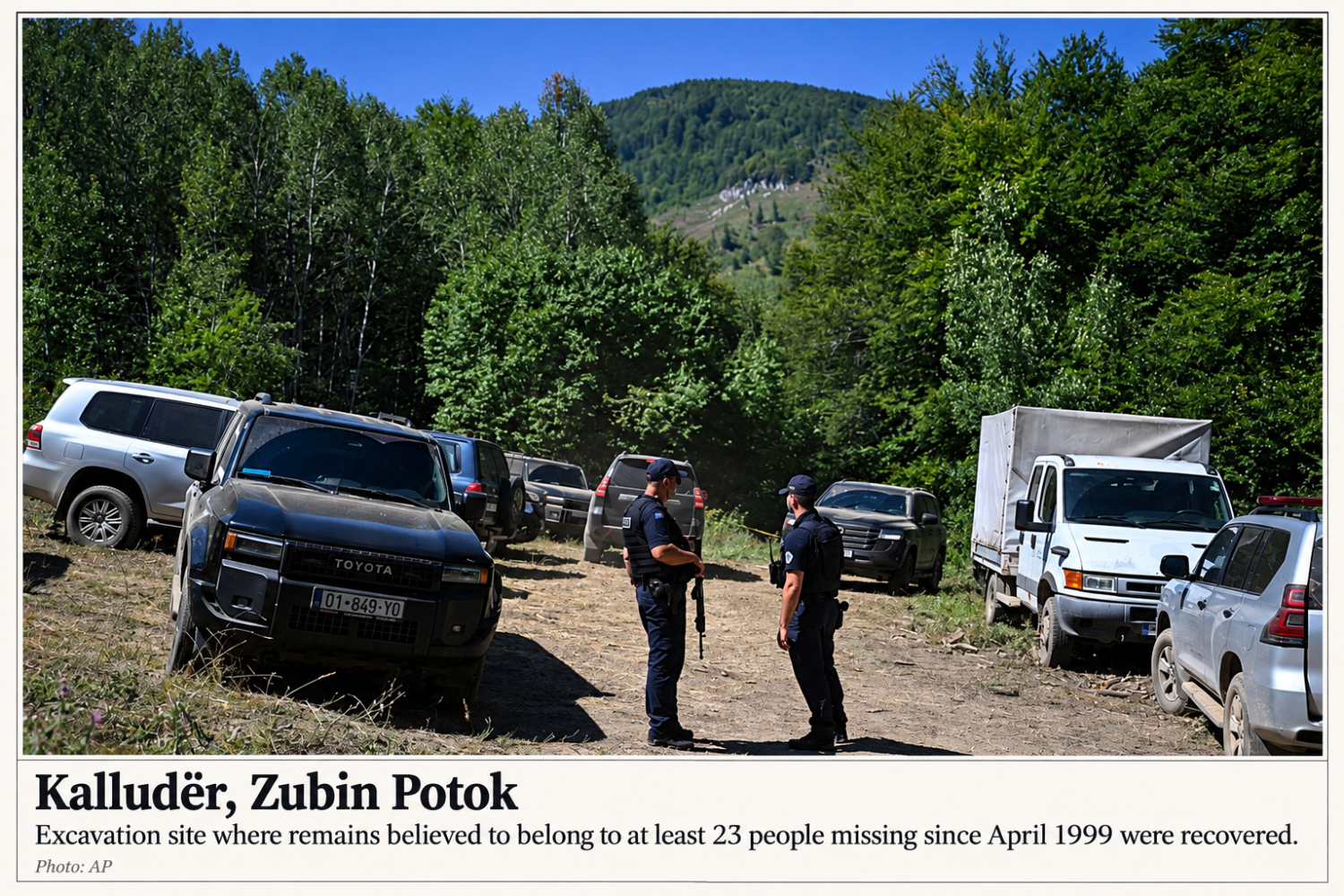
On 28 July this year, on a court order obtained by the Special Prosecution, excavations began at Kalludër e Vogël. A second site was found at Jabukë on 2 August, a third at Kalludër e Vogël soon after. On 21 August the Government Commission on Missing Persons announced the excavations complete, and on 24 August it put the count at remains believed to belong to at least twenty-three people across the three sites. The samples went to the Hague. On 19 September the first three DNA reports came back and matched members of the group. The families of the three were told the same day. Further reports are expected.
Three men were arrested at the end of July and in early August. A fourth on 3 September. This morning's operation, run by the War Crimes Investigation Directorate on the Special Prosecution's order, brought the total to thirteen. The nine are held for forty-eight hours. Nine locations were searched. Police list what they took: nine phones, two military service booklets, a long gun, a hunting rifle, ammunition, and cash.
The operation had a codename. The police called it File 23.
That is the number Belgrade did not say today.
Aleksandar Vučić went on RTS. "I hear that Kurti and his special forces have again been arresting Serbs, nine of them, in Zubin Potok, for alleged false war crimes." The world, he said, would keep quiet and play naive, "as if they did not know that this is the most perfidious and most rotten method of ethnic cleansing". He did not mention the twenty-three.
Belgrade's Office for Kosovo explained itself. Its statement called the arrests a pretext and the exhumations "recent discoveries" being used to hunt "all remaining Serbs". Then it said what Kurti was really doing: running a campaign to distract the Pristina public from the Hague indictments of KLA leaders, "with the wicked intention of creating an artificial balance so that the burden of war crimes would not lie only on the Albanian side".
The Office is not saying the nine are innocent. Its argument, followed through, is that after the Specialist Chambers convicted Thaçi, Veseli, Selimi and Krasniqi, the ledger was settled and any Serb arrest reopens it. Remains believed to belong to at least twenty-three people, found at three sites in a Serb-majority municipality, disturb that arrangement. So the remains become a pretext and the investigation becomes a campaign.
Srpska Lista wrote of "grave accusations from a period more than two and a half decades ago" presented "while the public has not been shown concrete evidence". Evidence that there was a crime was dug out of the ground in their own municipality over four weeks in August. The evidence against these nine men belongs in court. Within forty-eight hours of arrest they must be brought before a judge, who decides whether their detention continues.
Danijela Nikolić, who chairs the Serbian parliament's committee on Kosovo, wrote the most careful text of the four. An arrest is not a verdict, an accusation is not proof, detention is not punishment. She asked KFOR and EULEX to watch the proceedings, the right to counsel, the presumption of innocence.
She is right on every count, and EULEX and KFOR should do exactly what she asked. It was not the language Belgrade used while Hashim Thaçi spent nearly six years in detention in the Hague. The presumption of innocence entered Serbia's Kosovo vocabulary on the morning the suspects were Serbs.
All four statements are addressed to the same readers: KFOR, EULEX, "the international representatives", "the world". Belgrade writes to them because part of that audience has answered before.
EULEX forensic experts worked the sites at Kalludër e Vogël and Jabukë alongside Kosovo's Institute of Forensic Medicine. The British Embassy publicly welcomed the recovery of the remains and the DNA work to identify them. The institutions did their job: the sites were excavated, the remains recovered, identification begun.
On 9 September the President of France received Vučić at the Élysée, two days after Serbia buried Ratko Mladić with military honours. On 23 September the President of Serbia told the UN General Assembly that the humanitarian catastrophe of 1999 "did not occur". The message received in Belgrade is not hard to read: the record can be denied and the door stays open.
Twenty-seven years of that have produced a doctrine, and today's four statements are its application. In the doctrine, Serbs are the victims of the wars of the 1990s. The judicial record says otherwise. The ICTY found that the Yugoslav army and Serbian police ran an organised campaign to expel Kosovo's Albanians and convicted the officials who directed it. It convicted the JNA officers responsible at Ovčara. On Srebrenica the International Court of Justice found the genocide committed by the army of Republika Srpska and Serbia responsible for failing to prevent it. The doctrine survives on the courtesy of the people it is addressed to.
This is the artificial balance the Office means. The balance Belgrade wants is between a court that has convicted Albanians and a diplomacy that keeps receiving Serbia's leaders whatever they say about their own. Nine arrests over a mass grave threaten the second half of that balance, and so they are called ethnic cleansing.
Twenty-three people were taken from their homes on one day in April 1999 and never seen again. Remains believed to be theirs have now been recovered, and three of them have names. There is a word for that, and the President of Serbia used it this morning. He used it about the arrests. The question for KFOR, EULEX and the rest of the audience is whether they will hear it the way he meant it, again.
