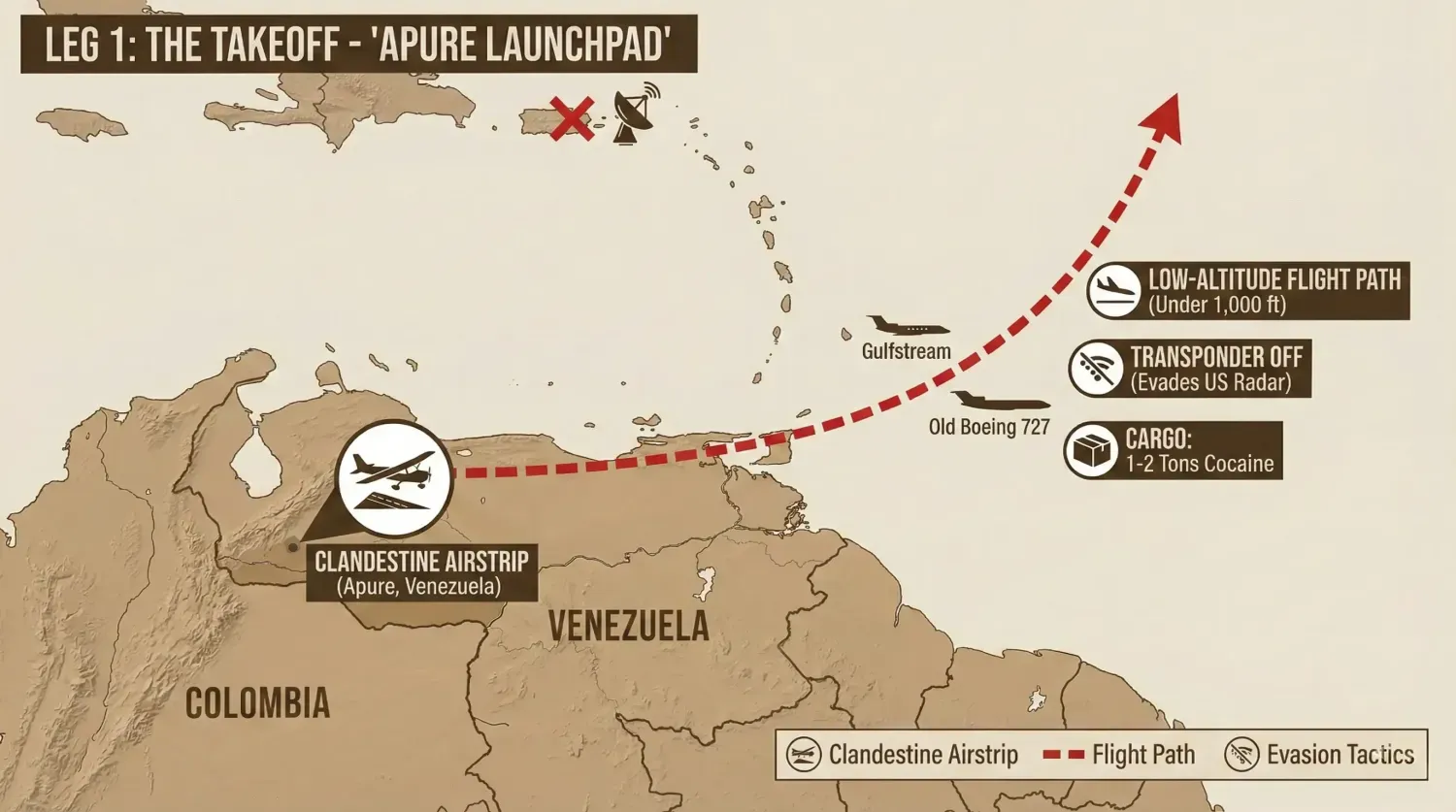
Venezuela is not a producer of cocaine, but its geography has made it a recurring transit point in the global drug trade. Over the past decade, that role has intersected episodically with criminal networks from the Western Balkans, groups now identified by European law-enforcement agencies as key intermediaries in moving cocaine from Latin America to Europe. Drawing on seizures, court cases, and expert assessments, this analysis examines where those links are documented, where they are overstated, and how flexibility — rather than fixed alliances — defines today’s trafficking routes.
by the Kosovo Dispatch | 11 January 2026
Venezuela has long occupied a particular place in the global cocaine economy. It is not a producer of the drug, but its geography, weak enforcement environment, and proximity to Colombia have made it a recurrent transit point for cocaine bound for foreign markets. Over the past decade, that role has increasingly intersected with criminal networks originating in the Western Balkans — groups that European law-enforcement agencies now identify as among the most capable logistics and distribution actors in the Europe-bound cocaine trade.
The connection is not constant, uniform, or exclusive. Venezuelan routes are neither the primary base nor the sole corridor for Balkan criminal organisations. Yet multiple seizures, court cases, and investigative assessments show that Venezuela has functioned as one of several operational nodes through which cocaine linked to Balkan networks has passed on its way to Europe.
This convergence — episodic rather than structural — sheds light on how contemporary cocaine trafficking works: flexible, decentralised, and adaptive to pressure rather than anchored to any single country or cartel.
A transit state, not a producer
International agencies, including the United Nations Office on Drugs and Crime (UNODC), consistently classify Venezuela as a transit country in the cocaine supply chain. Most cocaine passing through Venezuelan territory originates in neighbouring Colombia, with additional volumes linked to production and consolidation points in Ecuador and Brazil.
What makes Venezuela operationally relevant is not production capacity but geography. Its long Caribbean coastline, access to Atlantic routes, and limited surveillance capacity — particularly for small aircraft and non-commercial maritime traffic — offer traffickers multiple exit options. Cocaine leaving Venezuela can move directly toward Europe or first pass through secondary hubs, notably West Africa, before entering European ports.
This transit function has drawn in a range of external criminal actors over time, including networks from Europe.
Balkan networks in the global cocaine trade
Criminal organisations from the Western Balkans — including groups with roots in Montenegro, Serbia, Albania, and Kosovo — have, over the past two decades, transformed from regional trafficking groups into global intermediaries in the cocaine trade.
Europol, Interpol, and independent research organisations such as the Global Initiative against Transnational Organized Crime (GI-TOC) describe these networks as particularly effective in logistics, risk management, and international coordination. Rather than controlling production, they specialise in:
- negotiating directly with suppliers in Latin America,
- organising trans-Atlantic shipments,
- and overseeing wholesale distribution once cocaine reaches Europe.
Their strength lies in flexibility. Balkan groups rarely depend on a single route or country. Instead, they operate across multiple corridors, shifting geography when enforcement pressure increases.
Venezuela is one such corridor.
The Aruba seizure: a documented link
The most clearly documented case linking Balkan criminal networks to Venezuelan transit routes occurred in February 2020, when Dutch naval forces intercepted the vessel Aressa off the coast of Aruba, near Venezuelan waters.
The ship had previously docked at the Venezuelan port of Guaranao. On board, authorities discovered approximately five tonnes of cocaine.
Eleven members of the crew — all Montenegrin nationals — were arrested. In March 2021, courts in Aruba sentenced them to prison terms ranging from nine to fifteen years.
The operation was the result of coordinated law-enforcement work involving authorities from Montenegro, Serbia, the United Kingdom, and the Netherlands, with Europol playing a facilitating role.
Subsequent investigations connected the shipment to Miroslav Starčević, a Serbian national arrested in 2023 along with twelve others. Serbian prosecutors charged the group with international drug trafficking. The case is currently in the trial phase before the Higher Court in Belgrade.
Serbian police have described Starčević as the leader of one of the largest drug-trafficking organisations uncovered in the region, alleging responsibility for multi-tonne cocaine shipments from Colombia, Brazil, Ecuador, and via West Africa. Europol assessments linked the group to Montenegro’s Kavač clan, one of two rival criminal factions whose violent feud has claimed more than sixty lives since 2014.
The Aruba case does not establish Venezuela as a permanent base for Balkan trafficking operations. It does, however, demonstrate that Venezuelan ports and waters have been used in high-volume shipments involving Balkan crews and European distribution networks.
Why Venezuela matters — and why it is not central
Analysts caution against overstating Venezuela’s importance to Balkan groups. According to Saša Đorđević of GI-TOC, Venezuela should be understood as a strategic exit point, not a primary hub.
For Balkan networks, the most critical relationships remain in:
- Colombia, where cocaine is produced,
- Brazil, a major consolidation and export platform,
- and increasingly Ecuador, whose ports have emerged as key gateways for cocaine entering containerised shipping to Europe.
Venezuela’s role is therefore situational. When routes through Ecuador or Brazil become riskier, traffickers may turn to Venezuelan corridors. When pressure increases in Venezuela, they move elsewhere.
This adaptability explains why enforcement actions targeting individual routes rarely dismantle entire networks.
Transport methods and enforcement gaps
One feature that distinguishes Venezuela from other transit states is the diversity of transport methods used.
In addition to maritime shipments, analysts note the use of small aircraft, which face far less monitoring than commercial flights. These aircraft can move cocaine from Colombia into Venezuelan territory or onward to offshore transfer points with limited detection.
Maritime routes, meanwhile, include:
- containerised cargo,
- non-container vessels,
- and ship-to-ship transfers in international waters.
For Balkan groups, these methods are not unique to Venezuela. Similar techniques are used in Brazil, Ecuador, and West Africa. What Venezuela offers is an environment where state capacity constraints and corruption risks reduce the likelihood of consistent interdiction.
State fragility and criminal opportunity
International indices consistently rank Venezuela among countries where criminal actors exert significant influence within state structures. The Global Organized Crime Index places Venezuela in the highest tier globally for criminal penetration of the state.
GI-TOC reporting indicates that Colombian armed groups and criminal organisations operate in Venezuelan border regions in cooperation with corrupt officials, facilitating trafficking with relatively low levels of open violence. This environment lowers transaction costs for traffickers — including foreign partners — even if it does not place the Venezuelan state in direct operational control of cocaine flows.
This distinction matters. While political rhetoric often frames Venezuela as a centrally managed “narco-state,” most available evidence points instead to fragmented corruption, where different state actors enable trafficking opportunistically rather than through a single command structure.
For Balkan networks, this creates access without dependence.
Albania and the broader Balkan picture
While Montenegrin and Serbian groups feature most prominently in documented Venezuela-linked cases, Albanian criminal networks occupy a central place in the wider European cocaine market.
Law-enforcement and investigative reporting indicate that Albanian-language networks — spanning Albania, Kosovo, and diaspora communities in Western Europe — have become particularly influential in:
- sourcing cocaine in Ecuador and Colombia,
- organising containerised shipments to ports such as Rotterdam and Antwerp,
- and controlling wholesale distribution within Europe.
Direct, well-documented Albanian operational links to Venezuela are comparatively limited. Where Albanian networks intersect with Venezuela, it is typically through shared suppliers or transit corridors, rather than through permanent infrastructure or personnel stationed there.
This distinction underscores a broader point: Balkan organised crime should not be treated as a monolith. Different national and clan-based networks favour different routes, even as they collaborate when interests align.
Enforcement responses — and their limits
International cooperation has produced tangible results. The Aruba seizure, arrests linked to encrypted communication platforms, and ongoing trials across Europe reflect a level of coordination unimaginable two decades ago.
Yet law-enforcement agencies themselves acknowledge the limits of disruption. Balkan networks are:
- decentralised,
- financially resilient,
- and capable of rerouting shipments within weeks.
Moreover, information gaps persist. Police authorities in Serbia and Montenegro have declined to publicly clarify whether groups linked to Venezuela remain active on those routes today. Europol has stated that it has no direct cooperation with Venezuelan authorities and relies on intermediary intelligence from partner states.
This lack of direct access further complicates assessments of current activity levels.
A flexible system, not a fixed alliance
The relationship between Venezuela and Balkan drug cartels is best understood not as a stable partnership but as a point of intersection within a global system.
Venezuela provides:
- geography,
- exit routes,
- and an enabling environment shaped by corruption and weak enforcement.
Balkan groups provide:
- logistics,
- capital,
- and access to Europe’s wholesale cocaine markets.
Neither side depends exclusively on the other. That is precisely why the system endures.
As enforcement pressure rises in one corridor, traffic shifts to another. The underlying demand — and the profits it generates — remain unchanged.
Conclusion
Venezuela’s role in Europe-bound cocaine trafficking involving Balkan criminal networks is real, documented, and consequential — but also limited in scope.
It is a transit option, not the centre of gravity. The core of Balkan cocaine trafficking lies in long-standing relationships in production and consolidation countries, supported by a web of alternative routes stretching across the Atlantic.
Understanding this distinction is essential for policymakers and investigators alike. Focusing on individual countries risks missing the structural reality: a trafficking system designed to survive disruption by never standing still.
