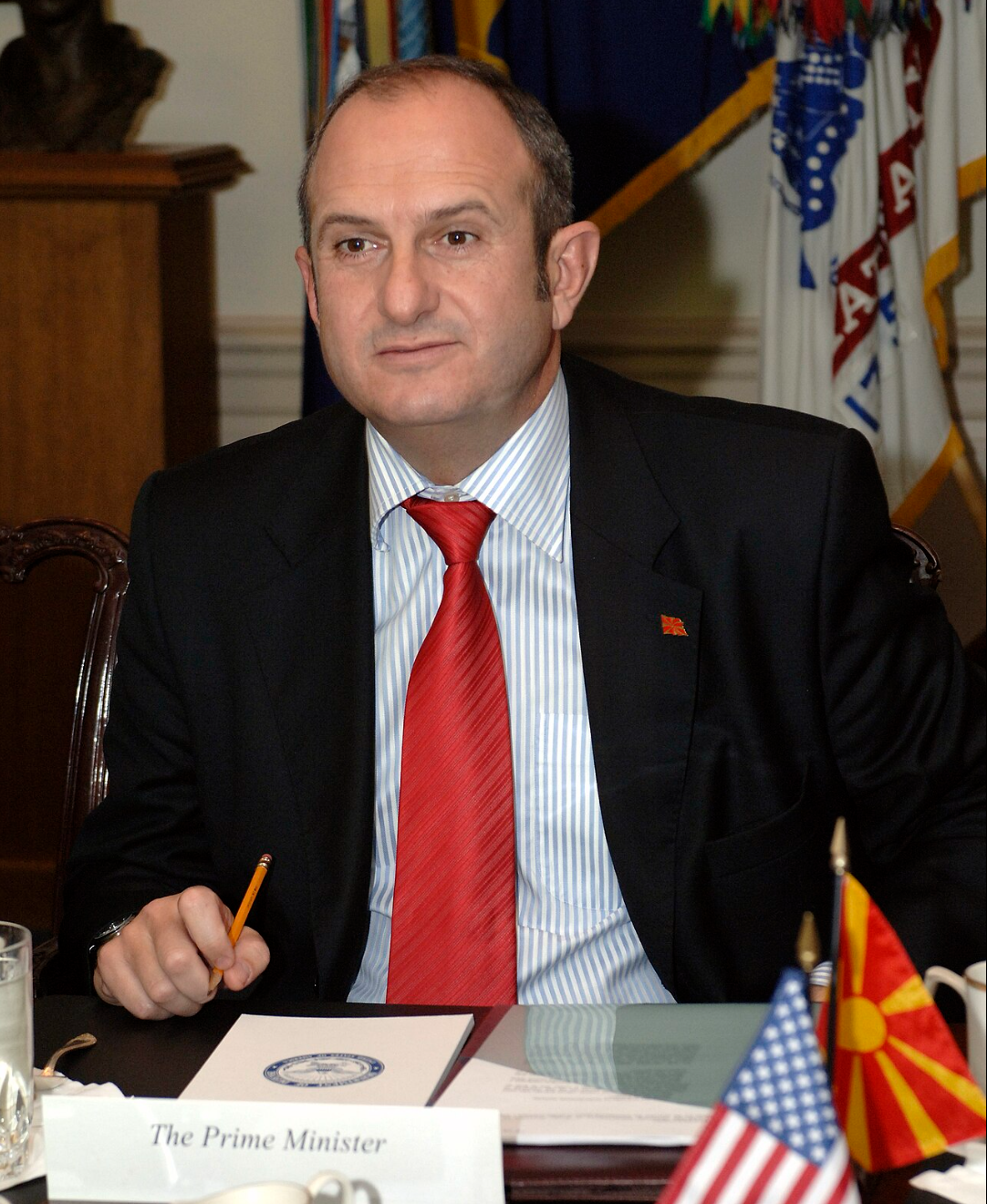
Interview conducted by the DC Bureau of The Kosovo Dispatch
Thomas R. Blake
U.S. Political & Security Correspondent
23 October 2025
In the Western Balkans, peace has lasted long enough to feel familiar — yet never long enough to feel safe. Two decades after the guns went silent, the region still lives between memory and uncertainty: weary of its own history, surrounded by Europe’s fatigue, America’s distraction, and the renewed ambitions of Moscow and Beijing.
To understand this uneasy moment, The Kosovo Dispatch sat down with Vlado Bučkovski, the former Prime Minister of North Macedonia who helped steer his country from conflict to coexistence — and from isolation toward NATO and the European path. Calm, reflective, and unsparing, Bučkovski is one of the few Balkan statesmen who speaks with both the memory of crisis and the language of strategy. He remembers how close collapse once was — and how easily fatigue can undo the hard-won calm that followed.
In this conversation Bučkovski reflects on Europe’s hesitation, America’s retreat, and the moral test facing his region: whether the Western Balkans can turn survival into stability — and stability into a peace that finally lasts.
THE BALKANS AFTER TWO DECADES OF PEACE ACCORDS
It’s been twenty-four years since the Ohrid Framework Agreement and seventeen since Kosovo’s independence. Have we finally built a durable peace, or are we simply managing fragility more elegantly?
Vlado Bučkovski: Just yesterday in London, at the Berlin Process summit, Prime Minister Keir Starmer called the Western Balkans “the kettle where Europe’s security is tested.” I would add — sadly, he’s right.
Two decades after our wars, the Balkans are no longer boiling, but the water still trembles. We live in what I often call a fragile peace: calm enough to make us comfortable, yet not deep enough to make us safe. Our societies are weary. Our institutions are stronger than before, but still not strong enough to stand on their own. Too often we mistake fatigue for peace, and silence for reconciliation.
Part of that fragility is our own doing. But part of it lies in Brussels. The European Union has been both our compass and our disappointment. It showed us the direction, then kept moving the destination. It asked for reforms but rewarded them irregularly. The result is a region caught between expectation and exhaustion.
Europe’s mistakes are not abstract — they have human costs.
The broken promise of membership. For years, we were told to keep walking toward the horizon of integration. But when that horizon keeps shifting, people stop believing there is a destination at all.
The “stabilitocracy” trap. In the name of predictability, Europe often embraced convenient leaders instead of courageous ones, choosing control over change. Stability became a slogan, not a structure.
The politics of veto and fatigue. Disputes such as those between North Macedonia and Bulgaria show how the past can still paralyze the future — and how a single member’s grievance can hold an entire region hostage.
Economic disillusionment. The promise of prosperity was never matched by results. Young people keep leaving; corruption seems easier than reform. Hope itself has become one of our main exports.
Taking peace for granted. Perhaps the most dangerous failure has been the belief that once the guns went silent, history would heal itself. But peace without justice, jobs, or purpose is only an intermission between crises.
Cynicism now fills the space where trust used to live. Populism thrives on disappointment. And when Europe hesitates, others — Russia, China, and others — rush in to fill the vacuum.
If the Balkans are truly where Europe’s security is tested, then the EU must rediscover its courage — and we must rediscover our own agency. The Western Balkans cannot remain a waiting room of history. Real stability will come only when Europe stops treating this region as its periphery and starts treating it as part of its unfinished peace.
LESSONS FROM 2001 – 2006
You governed during a tense but transformative era. What lessons from that period would you urge today’s leaders to remember when balancing ethnic reconciliation with national sovereignty?
Vlado Bučkovski: I still repeat the lessons of that period — because they remain as relevant today as they were in 2001. Back then, Macedonia was a frontline of fragility. We had just come out of conflict, our institutions were weak, and trust between communities was deeply wounded. Yet within four years, we managed something that many thought impossible: by 2005, we had achieved candidate status for EU membership. From a war to a European perspective — that was our miracle.
Building a multi-ethnic and multi-confessional state is never easy, but it is not impossible either. The key is patience — and courage. Patience to listen when emotions run high, and courage to make compromises that may be unpopular but save the future. The Ohrid Framework Agreement was not a victory for one side over another; it was a shared investment in survival.
Peace must be built every day. You cannot sign it once and then forget it. Reconciliation is not a photograph; it is a process — equal rights in practice, fair representation, and a political culture that treats diversity as strength, not threat.
Macedonia proved that the Balkans could change through dialogue, not division. If we did it in 2001, others can do it now — but only with honesty, empathy, and leadership that looks beyond its own ethnic flag. That is how sovereignty becomes meaningful: when it belongs to everyone who lives under it.
THE KOSOVO–SERBIA STALEMATE
The dialogue between Belgrade and Pristina seems frozen in ritual. Do you see any realistic path out of this impasse, or are we settling into a strategy of controlled stagnation?
Vlado Bučkovski: Unfortunately, without dialogue there is no progress. And what we are witnessing today between Belgrade and Pristina is exactly that — controlled stagnation.
Everyone keeps the process alive, but only just enough to avoid declaring it dead. Meetings are held, statements are issued, but the trust that once made dialogue meaningful has evaporated. Instead of moving toward normalization, the two sides now negotiate about the negotiations themselves. It has become a ritual of survival rather than a pathway to peace.
For years, the international community treated dialogue as a mechanical exercise — as long as the table was set, they assumed stability would follow. But a table without trust is just furniture. What we need now is not another photo opportunity, but a moral reset.
Serbia must stop using the dialogue to delay recognition, and Kosovo must resist the temptation to mistake pauses for progress. Europe and Washington must also be honest: controlled stagnation is not stability — it is slow decay. The longer it lasts, the more people lose faith in peace itself.
Having led a post-conflict country through reconciliation, I know that dialogue is not about liking your counterpart — it’s about respecting the future. When leaders stop speaking, history starts whispering again. And in the Balkans, history never whispers for long.
REGIONAL SECURITY ARCHITECTURE
NATO’s focus is split between Ukraine and the Middle East. How exposed does that leave the Western Balkans to new forms of influence — from Moscow, Beijing, or other revisionist actors eager to exploit fatigue?
Vlado Bučkovski: In our region, only Serbia, Bosnia and Herzegovina, and Kosovo remain outside NATO. That alone would not be a problem if there were stable dialogue between Belgrade and Pristina, and if Bosnia’s constitutional model were not in constant crisis. The absence of both makes our security architecture fragile — a structure that can easily bend, even break.
When NATO’s attention is divided, the Balkans slip down the list of priorities. Yet this is still the most sensitive corner of Europe’s periphery — a place where unresolved issues and external ambitions intersect.
Russia sees the Balkans as its strategic rear base in Europe. It doesn’t need tanks; it only needs divisions, disinformation, and delay. China uses investment as diplomacy — offering credit without conditions, infrastructure without values. Both strategies thrive on Europe’s fatigue.
Regional cooperation is therefore our first line of defense. NATO membership is a shield; trust between neighbors is the real armor. Every frozen conflict here is an open door for someone else’s agenda.
If the West wants lasting stability, it must treat the Balkans not as a finished story but as an unfinished responsibility. And we inside the region must finally act as partners, not patients waiting for treatment.
THE SECOND TRUMP ADMINISTRATION
President Trump’s return has revived a more transactional language in U.S. foreign policy. What does this mean for America’s engagement in the Balkans — and can the region hold steady without a consistent U.S. anchor?
Vlado Bučkovski: From experience I can say this: Macedonia’s stability — and the stability of our whole region — has always depended on American engagement. When the United States leads, we advance. When it turns away, old ghosts begin to whisper.
Today, under President Trump’s second term, the Balkans are not in Washington’s spotlight. That is understandable — the world’s crises are many — but it would be a mistake to treat our region as settled. America still has unfinished business here: not of conflict, but of consolidation.
Mr. President, the Balkans remain one of America’s genuine success stories. It was the United States that helped end the wars of the 1990s, guided Macedonia’s peaceful transformation, and defended Kosovo when no one else would. From that effort emerged two rare achievements:
North Macedonia, a country where Christians and Muslims, Macedonians and Albanians, share one homeland in peace;
Kosovo, a Muslim-majority democracy that is secular, pro-American, and committed to freedom.
In a world fractured by religious mistrust, this is not a small thing. It proves that U.S. leadership can build bridges where others see fault lines. These examples — Macedonia’s coexistence and Kosovo’s democracy — are America’s moral capital in the Muslim world. They show that freedom and faith can live together.
President Trump, this is your opportunity. A strong, stable, pro-Western Balkans fits perfectly with your strategic vision: peace through strength, partnership through respect, and stability without endless war. Supporting these nations is not charity — it is smart power.
If Washington wishes to speak to the Muslim world through moral example rather than military might, Kosovo is its living argument. And Macedonia is the quiet proof that coexistence works.
America should not walk away. It should claim the legacy it built — and protect it. Because the day the United States forgets this region, others will remember it for their own reasons.
EUROPEAN FATIGUE AND THE ENLARGEMENT PARADOX
The EU now speaks of “gradual integration” instead of full membership. Is this realism or resignation? Does it risk cementing a second-class Europe on the continent’s periphery?
Vlado Bučkovski: I am genuinely encouraged by the progress of Albania and Montenegro. If things continue, both could join the EU by 2029 — and they will deserve it. Their success proves the path is open for those who stay the course and make the hard choices.
But the rest of us are lagging. If North Macedonia fails to complete constitutional changes, and if Serbia continues to avoid reality, we will remain in what I call Europe’s second league.
“Gradual integration” sounds practical, but it risks formalizing a divided continent — one Europe with full rights and another perpetually waiting. That is not realism; it is resignation.
The danger is emotional as much as political. When people lose faith that Europe’s promise includes them, reform stalls and nationalism grows.
Enlargement is not charity; it is Europe’s self-preservation. The Western Balkans are not a burden — they are a test of Europe’s capacity to finish what it began. Our multicultural democracies — Macedonia, where Christians and Muslims share one homeland, and Kosovo, a Muslim-majority democracy that believes in the West — are Europe’s best arguments for hope.
If Europe loses that perspective, it will not only fail us. It will fail itself.
MACEDONIA’S BALANCING ACT
North Macedonia is safely in NATO but still waiting outside the EU door. How can Skopje keep faith in its Euro-Atlantic path while facing domestic exhaustion and rising populism?
Vlado Bučkovski: Macedonia has paid dearly for populism. The decade of former Prime Minister Gruevski cost us precious time — we lost our step with Croatia, which entered the EU more than a decade ago, and we waited ten extra years to join NATO.
Even today, I fear there is no atmosphere for a calm and honest dialogue about why we remain blocked on the European path. Instead of statesmanship and pragmatism, we see slogans and emotion.
Former NATO Secretary General Lord Robertson recently completed a study on Macedonia and issued a warning: without a credible EU perspective, North Macedonia could drift toward the Russian-Serbian orbit. That is the real danger.
Euro-Atlantic integration is not just foreign policy — it is our civilizational anchor. Without it, all the progress we made since 2001 could slowly unravel.
THE NEW ECONOMIC GEOGRAPHY OF THE BALKANS
From Chinese infrastructure loans to Europe’s green corridors, the region’s map is being redrawn. Where should the Balkans position themselves in this shifting economic landscape?
Vlado Bučkovski: Chinese involvement in infrastructure across Serbia, Montenegro, and Macedonia is unmistakable. The New Silk Road and the high-speed railway through our region are part of Beijing’s long-term design.
Yet Macedonia now has a counterbalance — the major infrastructure offensive led by the Bechtel-Enka consortium. These projects, linking us with Albania and Kosovo, show that Western capital can still compete when it acts with speed and purpose.
The Balkans should not be a battlefield of investments but a marketplace of fair competition. Our duty is to insist on transparency, sustainability, and European standards. Whoever builds here must also help strengthen our institutions, not weaken them.
THE ROLE OF REGIONAL LEADERSHIP
You once said that “small states can act as anchors of stability.” Do today’s leaders still carry that sense of responsibility?
Vlado Bučkovski: The deeper problem is the absence of genuine European leadership — both in Brussels and in our region. The EU now manages processes but no longer inspires them, and that vacuum is dangerous.
Among regional leaders, I see potential. The Albanian Prime Minister, for example, shows the instinct for broader vision — understanding that the Western Balkans can only advance together. But leadership is not about visibility; it is about moral discipline — the strength to tell the truth even when it costs votes.
We need fewer performers and more builders. The region has enough politicians. What it lacks are statesmen.
LOOKING AHEAD: THE MORAL TEST OF THE REGION
If you were speaking to the next generation of Balkan policymakers, what one value would you tell them to defend — so the region never again confuses the silence of fatigue with the strength of peace?
Vlado Bučkovski: Yes — time is running out. It truly is now or never. Either we catch up to Europe’s first league or remain trapped in the second division of history.
When I look back over twenty-five years, I see both miracles and mistakes. The miracle is that, after so much pain, the Western Balkans stand without war. The mistake is that we began to treat that absence of war as a substitute for real peace. We stopped building and started waiting — for Brussels, for Washington, for someone else to finish our work. But the moral of our story is simple: no one will save us if we stop saving ourselves.
The next generation must rediscover courage — the courage to listen before speaking, to build coalitions instead of walls, and to understand that patriotism is measured not by how loudly you shout, but by how wisely you compromise.
Real sovereignty means maturity: the capacity to cooperate, reform, and look ahead. If we want to belong to Europe, we must first act like Europeans at home.
We can no longer confuse fatigue with peace. Fatigue is what happens when hope is neglected; peace is what happens when hope becomes policy. The difference is leadership.
And to the young people of our region, I say: do not let cynicism win. Our generation cleared the path; yours must finish it. Europe may be tired, but it still listens to voices that speak with dignity and purpose.
Closing Remarks
Vlado Bučkovski speaks with the tempered calm of someone who has seen both the brink and the rebuilding. His words carry the weight of memory and the precision of a strategist.
For Brussels, his message is pragmatic but urgent: enlargement is not charity, it is Europe’s own insurance policy. For Washington, it is a reminder: the Balkans are not a forgotten battlefield but one of America’s few unambiguous success stories — a region where diplomacy, not division, defined the outcome.
And for the region itself, his challenge is deeply moral. Fatigue is not peace, and waiting is not policy. The future of the Balkans will depend less on summits or communiqués than on whether its leaders rediscover the courage to act like Europeans before being accepted as Europeans.
If the first miracle of the Balkans was the end of war, Bučkovski suggests, the second must be learning to live without fear — to turn fragile coexistence into lasting confidence. His message lingers: peace is not a gift to keep, but a responsibility to renew.