Serbia’s president recasts Kosovo as a Western plot and global disorder as Serbia’s opportunity — but the story he tells reveals a strategy of waiting, not peace.
By Mark Gojcaj | 26 January 2026
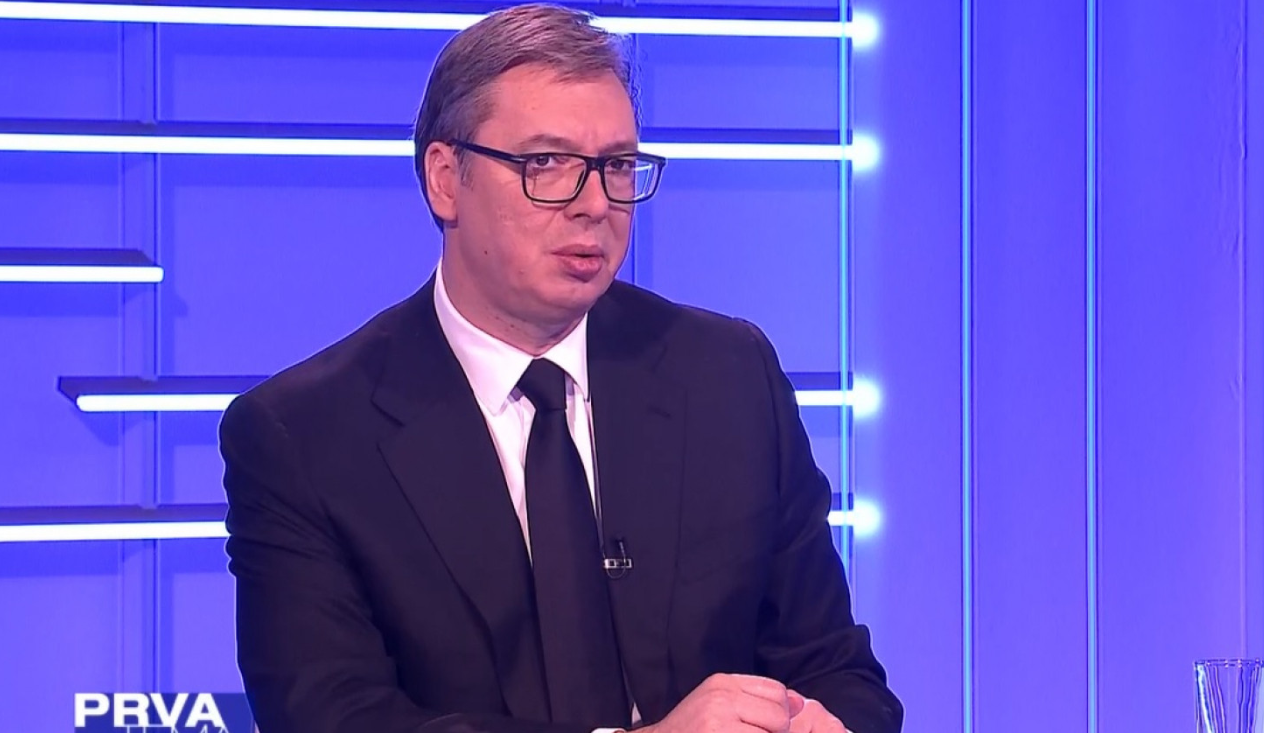
After returing from Davos, while speaking for TV Prva, Serbian President Aleksandar Vučić spoke less about compromise than about time.
It sounded like realism. It was something else: a narrative of grievance built to justify patience — and preserve a claim.
Each part of that argument deserves scrutiny.
“Kosovo was stolen through a staged humanitarian narrative.”
This is the foundation of Vučić’s story: that NATO intervened not to stop crimes, but to take territory.
What disappears from that version is the trigger. Kosovo’s autonomy was revoked in 1989. A decade of repression followed. By 1998–99, security forces were carrying out mass expulsions and killings. OSCE reports, ICTY indictments, and Serbian court rulings describe a campaign directed overwhelmingly at Kosovo’s Albanian population, culminating in nearly one million people forced from their homes.
One can debate NATO’s legality. One cannot erase why the intervention happened.
By turning Kosovo into a Western “project,” Vučić shifts responsibility outward. Serbian state violence becomes background noise. Serbia becomes the victim of a scheme. History is simplified into grievance.
“Greenland proves the world now admits it acts only by interest.”
Here, Kosovo is folded into a global metaphor.
Greenland is part of a sovereign state with constitutional self-rule. Kosovo emerged from war, UN administration, and a supervised independence process after mass displacement and documented crimes.
The comparison is not meant to clarify. It is meant to blur. If Greenland and Kosovo are morally equivalent, then Kosovo was not a consequence of repression — it was a transaction. The war fades. The people vanish. Power alone remains.
“10,000 Albanians and 6,500 Serbs were killed.”
This is the emotional pivot of Vučić’s case — and its weakest link.
Independent casualty research places total deaths at roughly 13,000–13,500. About 10,000–11,000 were Kosovo Albanians, mostly civilians. Serb and other non-Albanian deaths are estimated at 2,000–3,000, including combatants. Serb civilian deaths are closer to 1,200.
There is no credible dataset that supports 6,500 Serb victims.
The purpose of the number is not accuracy. It is symmetry. If suffering is balanced, then blame can be shared. A war of expulsion becomes a tragedy without authors. Statistics become a solvent for responsibility.
“Let the big ones fight. This is only an intermission.”
This is where narrative turns into doctrine.
Vučić does not speak of reconciliation. He speaks of waiting. The current order — including Kosovo’s independence — is treated as temporary, a pause between acts.
From Kosovo’s vantage point, this is not prudence. It is a refusal to treat normalization as final. Dialogue becomes something to endure, not complete. The future is imagined not as settlement, but as reopening.
“Serbia belongs to Europe, but Europe is declining.”
This is the balancing act: Europe as destination, but not as belief.
By calling Europe weak while insisting Serbia has no alternative, Vučić turns accession into logistics rather than identity. Europe becomes a waiting room, not a home.
That framing allows Serbia to benefit from EU integration while rejecting its central premise: that borders formed after war and crimes are not provisional.
“America should be thanked, despite Kosovo.”
Vučić praises Washington for avoiding sanctions and easing pressure, even as he accuses the West of stealing Kosovo.
It sounds contradictory. It is not. It is functional.
America is welcomed when it restrains itself. It is indicted when Kosovo is discussed. This lets Serbia engage Washington tactically without accepting Washington’s role in shaping the post-war settlement.
Gratitude becomes transactional. Legitimacy remains denied.
Kosovo as object, never subject
Throughout Vučić’s remarks, Kosovo is:
territory,
interest,
or deception.
It is never:
a society,
a political community,
or a population with rights.
If Kosovo is only a Western maneuver, then Kosovars themselves disappear from the story. Their experience becomes irrelevant to the outcome. That is not diplomacy. It is the erasure of agency.
Instrumentalizing Trump while waiting him out
There is also a quieter message aimed at Washington.
By citing President Trump’s blunt talk on Greenland, Vučić presents Trump as proof that world politics now admits it is driven by interest, not values. On the surface, this sounds like admiration. In practice, it is a way to retroactively discredit the humanitarian logic behind Kosovo.
Trump is not cast as Serbia’s ally. He is cast as evidence that Serbia was right.
At the same time, Vučić’s praise of the U.S. is narrow and transactional — focused on sanctions avoided and pressure restrained. It is not alignment. It is management.
Most telling is how Trump’s presidency is folded into the idea of “intermission.” The signal is that this moment, too, will pass. Nothing is final. Kosovo is not permanent. Trump is a phase, not a settlement.
It is a posture of quiet cynicism: use Trump rhetorically, tolerate him diplomatically, and outlast him strategically.
Disguised Hostility as Strategy
Vučić’s revisionism and cultivated victimhood are not about historical debate. They serve a strategic purpose.
By portraying Kosovo as theft rather than consequence, and by framing the present as an “intermission,” Serbia’s president is not preparing society for reconciliation. He is preparing it for reversal. The grievance is preserved. Kosovo’s legitimacy is denied. The settlement is treated as provisional.
The logic is direct: if Kosovo was taken through deception and power, then a future shift in power can justify taking it back.
That is why waiting matters. It is not neutrality. It is conditional restraint. Serbia is told to lie low, grow economically, avoid confrontation — and treat Kosovo not as a closed chapter, but as a deferred objective.
In strategic terms, revisionism becomes preparation. Victimhood becomes justification. Patience becomes doctrine.
What is being signaled is not acceptance of Kosovo’s independence, but readiness for a moment when geopolitical conditions might allow Serbia to challenge it again — politically if possible, coercively if necessary.
Kosovo is not presented as a neighbor to be recognized.
It is presented as territory to be recovered — when the world permits it.
