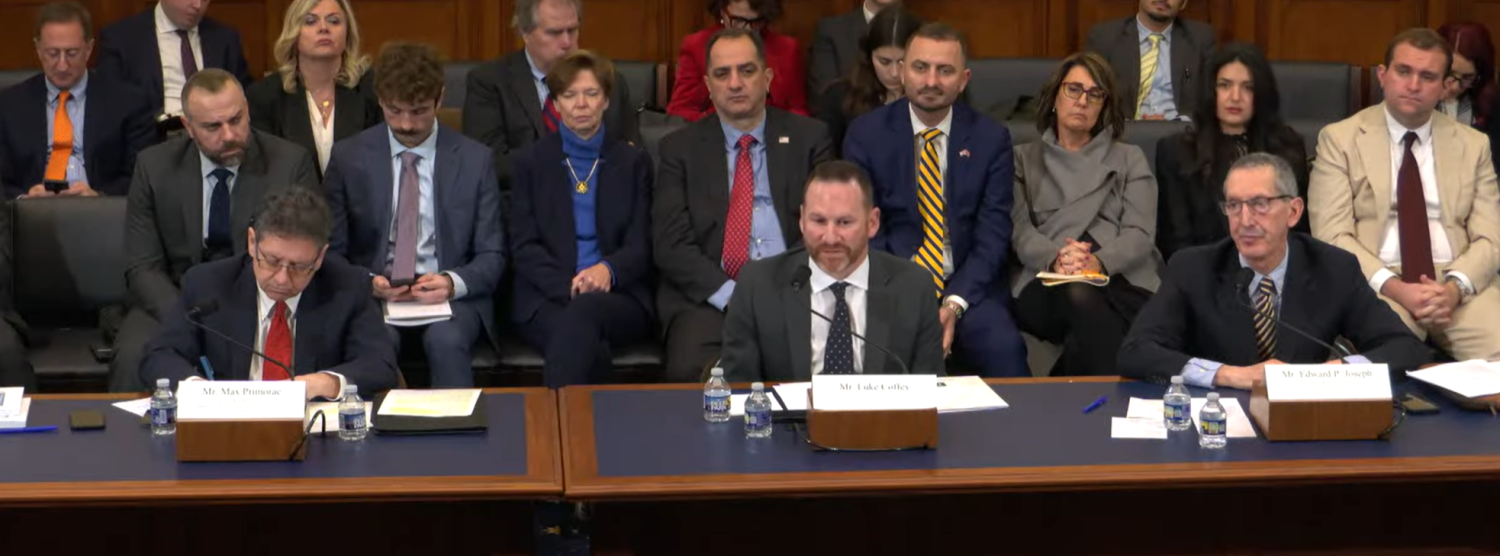
When the U.S. House Foreign Affairs Committee convened a hearing on Western Balkan stability this week, it was meant to be a broad strategic review: Bosnia’s stalled reforms, Serbia’s dance with Moscow, and the region’s vulnerability to Russian and Chinese influence. Instead, the session produced a far more pointed takeaway. In full public view, with bipartisan agreement rare for an election year, members of Congress and expert witnesses aligned on a single friction point: acting Prime Minister Albin Kurti is now seen in Washington as an obstructionist to stability.
The shift is significant. It arrives less than a month before Kosovo’s snap elections and at a moment when U.S.–Kosovo relations are already strained. What emerged in Room 2172 of the Rayburn Building was not a debate over whether Serbia deserves pressure — that was a given — but a new willingness to scrutinize Prishtina’s own political decisions, especially in the north. For the first time in years, Kosovo is no longer treated as a passive victim of regional turbulence. It is being evaluated as an actor whose choices can either stabilize or ignite the landscape.
In Washington, that distinction matters. And it will shape everything that follows on December 28.
DC Bureau - 3 December 2025
When the U.S. House Committee on Foreign Affairs convened a hearing titled Flashpoint: A Path Toward Stability in the Western Balkans on December 2, the mood was unmistakable: Washington is tired of drift, tired of improvisation, and increasingly willing to say out loud what diplomats have whispered for months. From the first minutes of questioning, the hearing made clear that the region is once again viewed as a potential ignition point — one capable of dragging NATO into a crisis at the worst possible moment.
And in a setting where Serbia’s flirtation with Moscow was the expected target, it was Kosovo’s acting Prime Minister Albin Kurti who unexpectedly took center stage.
For Prishtina, the message was unambiguous: Congress — Democrats and Republicans — now sees Kosovo’s internal political decisions as part of the region’s instability equation.
This shift matters. It arrives just weeks before Kosovo’s December 28 snap elections and amid visible U.S. irritation with Kurti’s governing approach. And unlike prior moments of bureaucratic grumbling, this one unfolded in public, on the record, in a room where bipartisan alignment is rare.
A Legislature on Alert: Why the Balkans Returned to Washington’s Radar
The hearing, chaired by Rep. Keith Self (R-TX), was not a routine oversight session. Held in the Rayburn House Office Building and streamed live, it took place against:
- escalating friction in northern Kosovo,
- stalled NATO and EU integration pathways,
- Russian and Chinese influence gaining ground, and
- lingering fears that Bosnia and Herzegovina could unravel.
Members repeatedly invoked a single metaphor: the Balkans as a tinderbox — not fully burning, but one spark away from demanding an Article V response.
Rep. Bill Keating (D-MA), the ranking member, sharpened the point by highlighting inconsistent U.S. sanctions policy, including the recent easing of measures on Milorad Dodik. Congress, in other words, fears strategic incoherence — and wants to reassert control over the narrative.
The Witnesses: Three Lenses, One Shared Alarm
The panel reflected Washington’s evolving thinking:
- Max Primorac (Heritage Foundation) emphasized Serbia’s deepening alignment with Moscow and Beijing, calling for a U.S.-led investment strategy reminiscent of the Abraham Accords logic.
- Luke Coffey (Hudson Institute) underscored the necessity of backing democratic reformers while confronting revisionists head-on.
- Edward P. Joseph (SAIS) brought a cautionary note: the entire regional equilibrium is wobbling because Dayton remains unfulfilled and the Kosovo-Serbia dialogue is frozen.
Despite ideological differences, the three converged on one theme: stability now depends on American engagement, not European bureaucracy.
The Moment That Stole the Hearing: Congress Labels Kurti an Obstructionist
The most replayed exchange of the day came when Chairman Self, citing news from Prishtina about the CEC’s refusal to certify Srpska Lista, asked the witnesses a blunt question:
“Do the bureaucrats at the Department of State see Albin Kurti as an obstructionist?”
In congressional language, this is not a question — it is an accusation wrapped in procedural form.
The answers were strikingly aligned:
- Joseph: “Yes.”
- Coffey: “Yes.”
- Primorac: “More yes than no.”
For Washington watchers, this was the pivotal moment. It revealed three layers of congressional frustration:
1. Kurti’s unilateral decisions in the north are seen as creating openings for Belgrade’s propaganda.
2. The CEC’s political composition is not well understood in Washington, leading some to misinterpret internal political dynamics as ethnic exclusion.
3. U.S. diplomats are now prepared to publicly distance themselves from a leader once seen as a reformist ally.
For Kosovo, the significance is clear:
Kurti is losing the benefit of the doubt in DC — and losing it at the worst possible time.
The Policy Ground Shifts: From Aid to Leverage
Witnesses and lawmakers coalesced around a policy blueprint that departs sharply from the last half-decade of U.S. Balkans engagement:
1. Conditioned Aid to Kosovo
Support should depend on:
- enabling Serb political participation,
- de-escalating in the north,
- recommitting to dialogue mechanisms.
2. Sanctions and Pressure on Serbia
Congress is frustrated with Vučić’s Russia balancing act and wants:
- sanctions on Belgrade-linked actors,
- energy diversification away from Gazprom,
- tighter monitoring of Chinese financing.
3. A U.S.-EU Infrastructure Initiative
Primorac’s proposed $10B+ fund to anchor the region economically in the West is gaining traction.
4. Fast-Track NATO Pathways for Kosovo — Only After Recognition
Coffey made the case most explicitly: Kosovo cannot remain indefinitely outside NATO if Washington expects long-term stability.
Balkan Focus vs. Kosovo Spotlight: Why Prishtina Drew More Heat Than Expected
The hearing’s formal agenda covered Bosnia, Serbia, Russia, China, and the entire Western Balkans. But Kosovo dominated media coverage for one reason: the obstructionist label was said clearly, repeatedly, and without rebuttal.
Regional media amplified it:
- In Kosovo, outlets framed the exchange as a rebuke of Kurti personally.
- In Serbia, nationalist media used it to argue that “even America now doubts Prishtina.”
- In Bosnia, Croat political actors used the hearing to highlight their own grievances under the Dayton system.
The Election Shadow: Why This Hearing Matters on December 28
With Kosovo heading into snap elections, Washington’s tone matters. It will shape:
- How diplomats speak privately to party leaders,
- How allies view the legitimacy of policy decisions made in caretaker mode,
- Whether a post-election government is expected to reset relations with DC.
What emerged in Room 2172 is not neutrality. It is judgment. And in Washington, judgment precedes policy.
If Kurti returns to power, the U.S. will demand course correction.
If a new government emerges, Washington will expect rapid re-engagement and normalization steps.
Either way, Kosovo will no longer receive unconditional political sympathy simply because Serbia behaves worse.
Bottom Line
The December 2 hearing did not change U.S. policy, but it clarified something more important: the patience of Congress is not infinite, and the credibility of Kosovo’s leadership is increasingly on the line.
Washington is re-entering the Western Balkans with sharper edges and fewer illusions.
Prishtina is now part of the problem set — and potentially part of the solution, but only if it chooses to be.