A note to Washington, and an invitation to the pastor himself
By Klea Ukaj | 6 July 2026
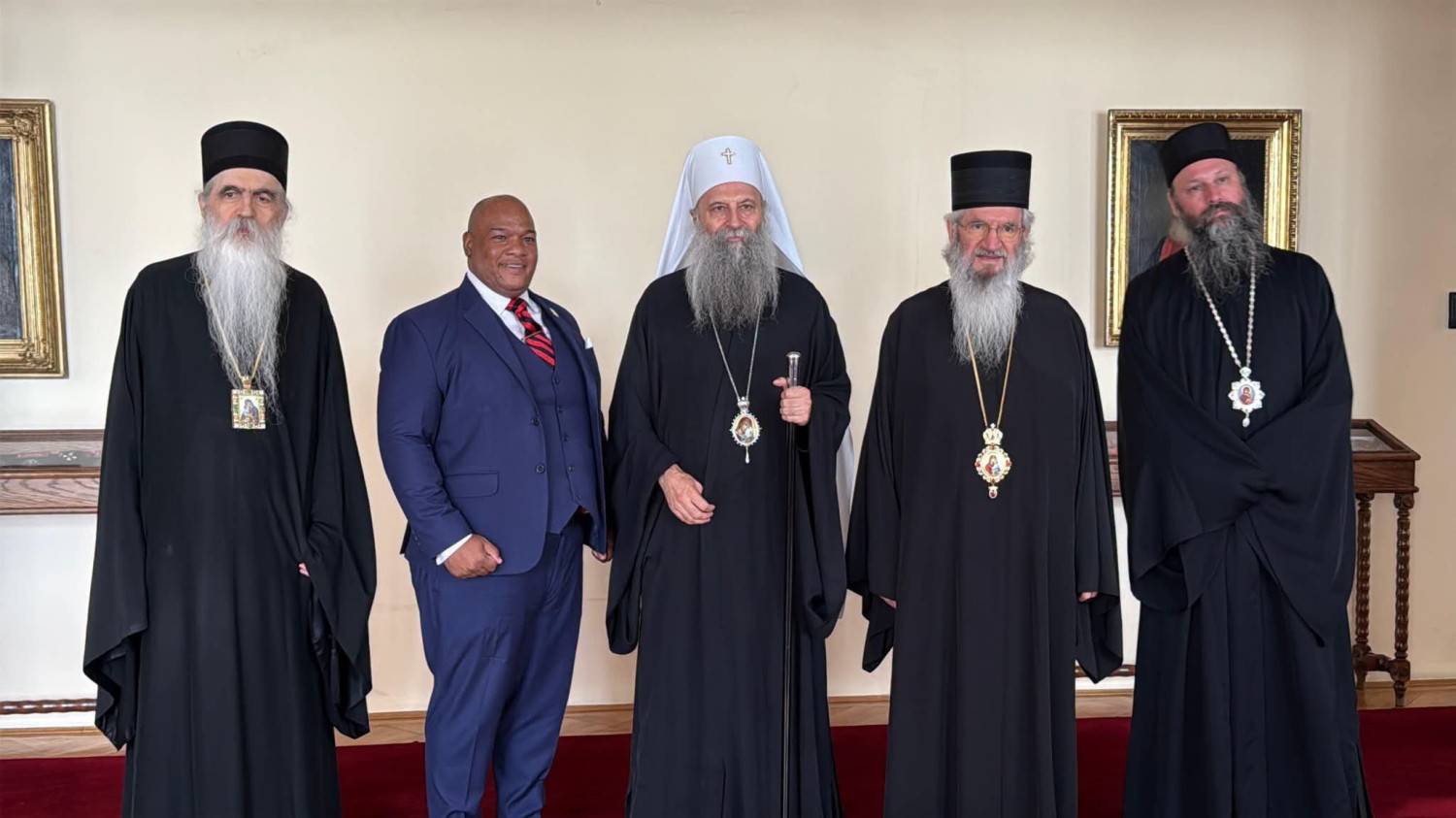
Pastor Mark Burns arrived in Belgrade on July 3 and announced, before a single meeting had concluded, what he had come to discuss: "the persecution of Christians in Kosovo." By that evening he had upgraded the claim, posting that he had spoken with Patriarch Porfirije about "war crimes against the Serbians." Two days later he crossed Kosovo's border in the Patriarch's own delegation, toured the Patriarchate of Peja, and declared that he had not come to deepen division but to listen.
We take him at his word. This piece is written on the assumption that he meant it, and it ends with what listening would actually require. But first he should know, and Washington should know, what was arranged around him while he prayed.
What his hosts did not mention
Burns knows, better than most public men in America, what it feels like to be sold a false persecution narrative. He has spent the past year telling anyone who will listen that he once believed Ukraine suppressed religious freedom, that he repeated the claim on every network that would have him, and that all of it was manufactured by people with an interest in his believing it. His correction came the honest way. He went. He saw Bucha and Irpin, met religious leaders across faiths without minders, and changed his mind at real cost to his standing in his own political world. Ukraine decorated him for it. That record is why this newspaper addresses him as a man capable of looking again, and it is also why last week is so hard to understand.
The Belgrade meeting where he absorbed the story of Kosovo's persecuted Christians was attended, according to the Serbian Patriarchate's own communiqué, by the co-founder of an outfit called Serbians for Trump. The host who briefed him, Patriarch Porfirije, stood beside Vladimir Putin in Moscow in April 2025, has called Serbia's own student protesters a Western color revolution, and once said the question of Kosovo was settled by a referendum held in 1389. The pastor who learned in Ukraine that Russians had lied to him about religious freedom took his Kosovo briefing from a cleric whose Kosovo policy, by the cleric's own statement, depends on Russia's global position. Nobody in the room was going to tell him that. Nobody in the room told him the age of the story either. When the residential quarters of the Patriarchate of Peja burned in March 1981, Serbian public memory recorded an Albanian arson attack, and records one still, although the investigation at the time attributed the fire to a defect; this spring, on the anniversary, Serbian outlets were once again presenting the blaze as the opening act of a war on the Serbian Church. What reached Burns was not a fresh grievance. It was the 1981 story, in circulation longer than most of his congregation has been alive.
And nobody, it seems, invited him to notice the contradiction inside his own itinerary. On departing, he publicly thanked the Kosovo Police for their professionalism and hospitality in securing his visit. A state that persecutes Christians does not usually assign a police detail to protect the man who came to denounce it.
Three days earlier, in the same palace
Here is the part that matters most for anyone in Washington reading this, because it is not about atmosphere. It is about dates.
On June 30, in the Patriarchal Palace in Belgrade where Burns would sit on July 3, Patriarch Porfirije pinned the Order of Saint Sava, second degree, on Danica Marinković, citing her long and persistent service to truth and justice and her contribution to illuminating the suffering of the Serbian people in Kosovo.
Danica Marinković was the Serbian investigating judge for Reçak, the January 1999 massacre of 45 Albanian civilians that moved NATO, under an American administration, toward intervention. She has spent twenty-seven years insisting there was no massacre and the dead were terrorists, in Belgrade, in Moscow's media, and on the witness stand as a defense witness for Slobodan Milošević. The international tribunal examined Reçak in the Đorđević case and found that at least 45 Albanians were killed, that some twenty to twenty-four had close-range gunshot wounds to the head, that one victim had been beheaded, that a woman and a child were among the dead, and that on January 18, 1999, Serbian police staged a false crime scene for the investigating judge who came to examine it. She was that judge. The Serbian Orthodox Church has now conferred its highest honor, for service to truth, on a woman who walked through a staged set and has vouched for it ever since.
Now set the dates side by side. June 30, the Church decorates the denier. July 3, Sputnik Serbia publishes Marinković declaring the order a confirmation that she was right, a Serbian minister grounds the decoration in testimony that Serbia's own Humanitarian Law Center documented as extracted under torture, and that same day Burns sits with the Patriarch and tweets about war crimes against the Serbians. July 20, a court in Pristina opens the trial of twenty-one men indicted for Reçak. Burns did not stumble into a pastoral visit. He arrived, on schedule, in the middle of an operation built to move a massacre beyond the reach of the courtroom about to examine it, and within hours his own account of the meeting was carrying the operation's vocabulary. I do not believe he knew. That is the charitable reading, and I hold to it. But it means he was used, in real time, with a precision that should trouble every office in Washington that manages what the President's name is attached to abroad.
And this is the same Patriarch whose vocabulary of suffering runs in one direction. His church mourns Serbian victims by name and by liturgy, as a church should mourn its dead. For the thousands of Albanian civilians killed by the Serbian state's war machine in 1998 and 1999, Reçak among them, that ministry has found no comparable word. Last week it found something worse than silence: a medal for the woman who says the signature atrocity never happened.
Questions for the building on C Street
The United States keeps an embassy in Pristina, one of its most robust diplomatic presences anywhere relative to the country's size, alongside a KFOR deployment that has kept the peace for twenty-seven years and a State Department that publishes an annual religious freedom report covering Kosovo in granular detail. Those reports document incidents against religious sites of every community, Muslim sites most numerous among them, and they describe nothing that any professional would call a persecution of Christians. So the questions write themselves, and congressional staff should feel free to borrow them. Did anyone from the United States mission confirm to Pastor Burns the claim he carried into the region? Was the embassy consulted, or even informed, before a man introduced at every stop as the spiritual adviser to the President of the United States lent that title to Belgrade's central foreign policy claim? Did anyone tell him, before or after July 3, about the decoration his host had conferred three days earlier, and about the trial that opens July 20? If not, a private citizen was left to freelance American religious diplomacy in a theater where American soldiers stand guard. If so, someone cleared it, and that is a larger conversation.
His formal status is part of this, because Belgrade has worked hard to inflate it. Burns holds no Senate-confirmed position and no publicly documented appointment. American reporting describes an informal adviser operating outside the chain of command, and congressional committees have confirmed no notification of any diplomatic role. The Serbian Patriarchate's communiqués nonetheless styled him, at every stop, as adviser to the President of the United States, an upgrade Belgrade needs, because the photographs from Peja exist so that Serbia can present American endorsement of a narrative Washington has never endorsed. Every day the administration declines to clarify the pastor's standing, those photographs work a little harder, and they work against the administration's own hand in the region.
Because the interests here are not abstract. Kosovo is Muslim in majority, secular in constitution and temperament, and, by nearly every survey that measures such things, the most pro-American country on earth. It names boulevards after American presidents of both parties. Under President Trump's own 2020 Washington agreements it took the political risk of recognizing Israel and opening an embassy in Jerusalem while much of the Muslim world balked. A president who has invested serious capital in building a pro-American axis within the Muslim world, from the Abraham Accords to the Gulf, has in Kosovo the easiest case on the planet, a Muslim-majority society that needs no persuasion and no leverage to stand with the United States, because it already does, by conviction. The civilizational frame Pastor Burns carried into the region, Kosovo as a Muslim threat to Christian survival, was invented in Belgrade to poison exactly this asset. The only beneficiaries of an America that treats Kosovo as a threat to Christendom sit in Belgrade and, behind Belgrade, in Moscow, where the Christian persecution genre was refined into the instrument that has already burned Pastor Burns once.
An invitation
So here is the invitation, Pastor, offered in good faith and on the record.
Come back. Not in a Patriarch's delegation and not in ours. Come the way you went to Ukraine, on your own terms, with your own eyes. Reçak is forty minutes from Pristina; the gully is still there, and so are families who buried forty-five of their own and have waited twenty-seven years for a courtroom. The trial opens on July 20 in Pristina, in public. Sit in it for a morning. Then drive into the city and visit the Cathedral of Saint Mother Teresa, because the most famous Christian of the twentieth century, canonized a saint of the Catholic Church, was born Anjezë Gonxhe Bojaxhiu to an Albanian family with roots in Prizren and Gjakova, two cities in the country you were taught last week to see as Christianity's adversary. Her people built her a cathedral in a Muslim-majority capital, named their national highway for her, and filled her squares with her image, Muslim and Catholic together. Nobody on your itinerary was ever going to mention her.
And on the way out of town, stop at the Bedri Kamberi mosque and ask for Imam Labinot Maliqi. Every Fourth of July, in the courtyard of his mosque, he raises the American flag to the sound of the American anthem and tells his congregation that the United States stood by his people when their existence hung in the balance. He has thanked President Trump by name. As far as anyone can establish, it is the only place in the world where Independence Day is honored at a mosque. He asks nothing in return. You said you came to the Balkans to listen. He is easy to find, and unlike the men who briefed you in Belgrade, he has nothing to sell.
You changed your mind about Ukraine because you went and looked. Kosovo asks only the same.
Klea Ukaj writes on transatlantic affairs from Michigian.