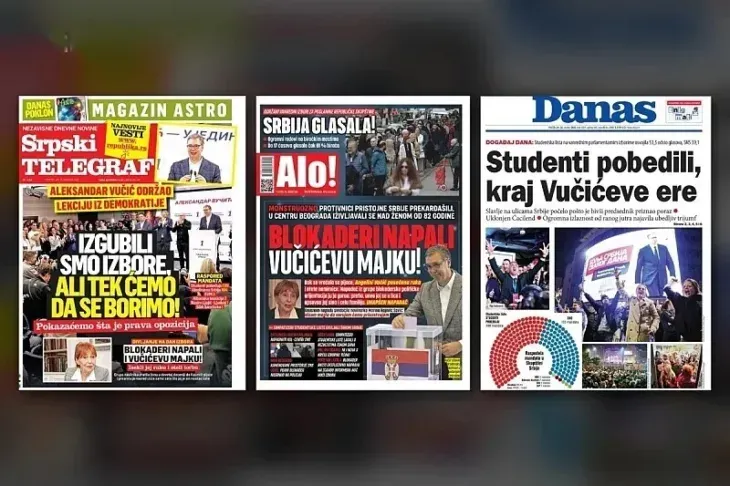
For three weeks Serbia's winners and losers used Kosovo against each other. In the fourth, a heritage bill voted in Prishtina had them saying the same thing, under one man's name.
Newsroom | 27 November 2026
In the small hours of November 20 the Kosovo Assembly passed, at first reading, a draft law setting up a Central Inspectorate of Cultural Heritage. This publication read 113 items on Kosovo from Serbian and Kosovo Serb media in the week that followed. Twenty-seven name the bill. Forty-two are about the Serbian Orthodox Church and its property.
In four weeks of this review it is the first subject on which both sides of the new Assembly in Belgrade have said the same thing. The argument in the first week was over who pays Kosovo's Serbs, in the second over who speaks for them, in the third over who betrayed them. This week the Diocese of Raška-Prizren said it had not been consulted and that the draft leaves out the Special Protective Zones and the council that oversees them. Srpska Lista filed amendments. Petar Petković, still running the outgoing government's Office for Kosovo, wrote to the EU's dialogue envoy and the Quint ambassadors asking them to demand the withdrawal of Prishtina's acts. The Student Movement asked international representatives to follow the procedure. Jugoslav Gašić, a Student List deputy, said: "As early as tomorrow we will have meetings with representatives of the international community, at which we will set this problem as a priority."
Novosti noticed. The people who had ruled out any cooperation with Srpska Lista and talked of its leaders' criminal liability, it wrote on November 23, now saw the way out in amendments in the Prishtina assembly. Srpska Lista, the paper added, had already filed them. Its headline was "What Gašić announces, and what Srpska Lista has already done". It is the fourth case made for the party in four weeks. First it was the payroll, then every job and benefit, then the nine votes that block constitutional change. Now it holds the seats in the chamber where the Church's property is decided.
Nemanja Karović of the Student List said on November 26 that the first task in Kosovo is to examine what the Office and Srpska Lista did with people and with money, and that restoring the ministry for Kosovo, abolished in 2012, would be an excellent idea. The agreement stops at the church door.
Last week this review found Prishtina cast as the party that reacts. This week it acted, and Kosovo's own office-holders supplied the material. Nenad Rašić, the Serb minister in Albin Kurti's government, said the bill falls under Article 81 of the constitution and needed a double majority. The deputy Ombudsperson, Srđan Sentić, opened proceedings on his own initiative. The Diocese accused a Vetëvendosje deputy, Arbër Rexhaj, of disputing the Serbian identity of the Orthodox monasteries during the debate and said his words bore the marks of hate speech. On November 26 an Albanian flag and a KLA flag were placed on Srpska Lista's seats in the chamber and later removed. The OSCE mission asked legislators to consult everyone affected, religious communities above all.
Kurti's name stood in the headlines of two items in the first week's sample, three in the second and four in the third. This week it is in nine. "Kurti tightens the noose around Serbian churches," Politika wrote, joining the bill to stones thrown by persons unknown at a belfry in Cernicë (Cernica), near Gjilan (Gnjilane). Novosti had "Kurti is arming dangerously" over a list of Kosovo Security Force purchases, RT Balkan "The dangerous dreams of Albin Kurti" and Sputnik "The arrogance of Kurti's regime". An Austrian who offered Belgrade the euro in exchange for recognition became "Kurti's lobbyist". A vote of the Assembly, lakeside cabins demolished at Ujman (Gazivode) on a ministry's order and a defence shopping list all went out under the prime minister's surname.
Last week he was the accomplice each Serbian camp assigned to the other. Novosti kept that up, headlining his remark to Politico that he is optimistic about Serbia's new leadership. Everywhere else he was simply the author.
Petković's letter to the Quint was the first of several approaches. The caretaker foreign minister, Marko Đurić, raised the bill with the US chargé in Belgrade. Srpska Lista took it to UNMIK and to the German ambassador, and the head of UNMIK met two Student List deputies in North Mitrovica the same week. The head of Serbia's UNESCO commission said an inspector's oversight would conflict with the organisation's rules. A member of the Swiss upper house asked his government for a report on the rights of Kosovo's Serbs.
Milan Radoičić now has three reported whereabouts in three weeks: Moscow, Republika Srpska and, by Nova's source, Kyrgyzstan. None is confirmed. A former BIA inspector, Milan Zvezdanović, spoke of serious suspicions that the agency's Second Directorate had been passing Radoičić information. Ana Dimitrijević, a Student List candidate back from Brussels, said the security of Kosovo's Serbs and respect for what has been agreed must be the priority, days after a colleague in the Assembly called the first of those agreements treason. The summit of EU and Western Balkans leaders on November 25, on which last week's review closed, does not appear in any of the 113 items.
Serbia votes for a president on December 27. Nothing in the sample gives a date for the bill's second reading. Until there is one, Belgrade has a subject on which it has no opposition, and it is addressing it to the embassies in Prishtina.
This publication's weekly review covered 113 items published by Serbian and Kosovo Serb media between November 20 and 26. It is the fourth in the series.