A government made a decision. A president answered the criticism on behalf of a nation that was never asked.
by Ngadhnjim Brovina | 9 September 2026
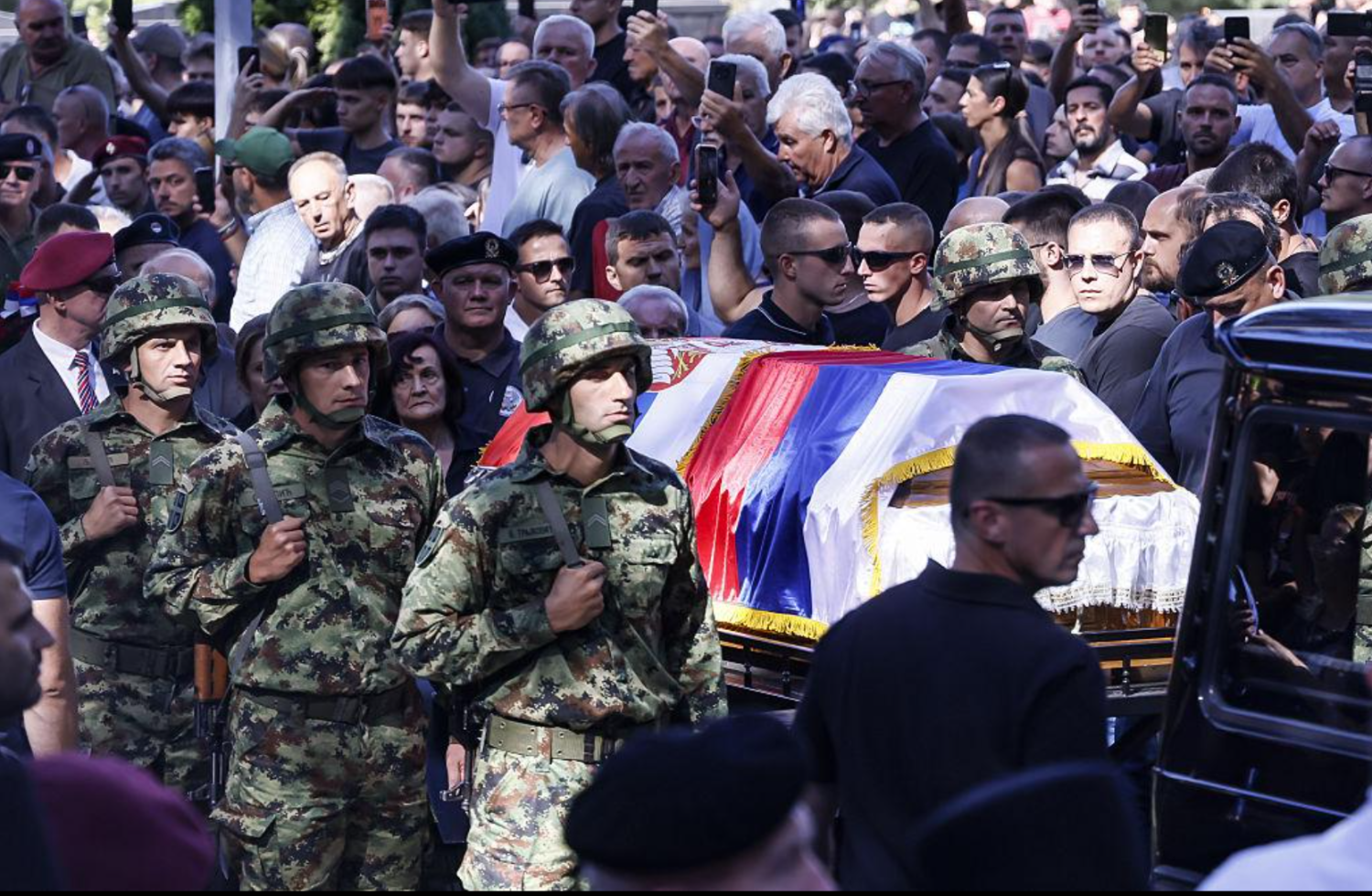
The decisions of the past week can be listed, and each has an author. A Serbian government aircraft flew to the Netherlands to collect Ratko Mladić's body, with Serbia's justice minister, Nenad Vujić, aboard. Members of the Army of Serbia received the coffin on the apron. The commemoration on Saturday was held in the Serbian Army's house in Belgrade, with Vujić in the audience. On Monday at least five Serbian government ministers attended the funeral at St Luke's, including the defence and justice ministers. At Topčider, personnel of the Army of Serbia placed the coffin on a gun carriage, escorted it to the family grave and fired the salute. Every item on that list was decided by an office holder. None of it was put to the citizens of Serbia, and none of it was required of them by anyone.
The consequences began before the burial and hardened after it. Marta Kos's 9 September visit to Belgrade was cancelled. An EU diplomat told Euronews that the opening of Cluster 3 was "completely out of the question for now." Croatia's prime minister said publicly that a reaction left at spokesperson level was "very bad," and by Tuesday morning the presidents of the Commission and the Council had posted identical texts naming "the elements of official support" and "the presence of some senior Serbian officials" as a contradiction of "the values underpinning Serbia's path towards the European Union." Bosnia expelled two embassy officials and withdrew its staff. Britain summoned the Serbian chargé d'affaires and condemned the involvement of Serbian "state and military officials."
Official support, senior officials, state and military officials, the manner in which he was honoured: each formulation points back to the people who took the decisions on the first list, not to Serbia's citizens.
Aleksandar Vučić answered them on RTS on Tuesday night. He did not say a government had taken a decision and would stand by it. He said: "Glavna meta napada, naravno, sam bio ja, ali je bila i Srbija." The main target was, of course, me, but it was also Serbia. He said the funeral had served as an "alibi" for the reactions from Sarajevo, Kosovo, Zagreb and Podgorica to show "koliko mrze Srbiju i koliko mrze njen uspeh," how much they hate Serbia and its success, and gave the reason: "zato što Srbija brže raste i brže napreduje," because Serbia grows and advances faster. He said Serbia has been blamed for everything for thirty-five years. He said those now objecting are the same people who "učestvovali u obojenoj revoluciji," took part in the colour revolution, and wanted a Serbia that would build "pasja groblja," dog cemeteries, for its generals.
Set the two lists side by side. Decisions taken by Vučić's government, criticism addressed to Vučić's government, and a reply in which the criticised party is Serbia. In the space of one interview the honours ceased to be a policy and became a national attribute, and objecting to them became hostility to the nation. A government makes a choice that damages the country's European standing; when the damage arrives, the government reports it to the country as proof that Europe is hostile.
Kosovo and Russia have been the standing explanation. For years the public account of Serbia's stalled accession has centred on two issues: normalisation with Kosovo and alignment with the Union's foreign policy, above all on Russia. Both are genuine accession problems and neither is going away. But neither produced the consequences of this week. Kos did not cancel over Kosovo. The diplomat who spoke of Cluster 3 did not cite Moscow.
Cluster 3 had already been blocked by eight member states in July. What the honours added was new and immediate: a cancelled visit and a declaration that opening was out of the question for now. The cause was a funeral escort Serbian authorities chose freely, in a form they alone determined. Nobody in Brussels or the region asked Belgrade for Mladić to be honoured.
The bookend is twenty years old. On 3 May 2006 the Commission called off negotiations on the Stabilisation and Association Agreement because Serbia had not met its commitment to full cooperation with the tribunal, and the Commission's report named the failure to locate, arrest and transfer Ratko Mladić. Mladić then obstructed Serbia's European path because the authorities failed to arrest and transfer him. Mladić now obstructs it because the authorities chose to honour him. In both cases the decision was taken in Belgrade by people holding office. In both cases the country paid.
The cost falls on identifiable people. The pro-European opposition preparing for the October election must now argue for a Union whose officials have just said further accession movement is out of the question for now, while the government that created the new obstacle campaigns against them as agents of that Union. The students who have spent two years on the streets are, in Tuesday's telling, part of the colour revolution the region supported. Vučić has arranged matters so that the European consequence of his decision arrives as an electoral argument in his favour.
The question in the title has a plain answer. Serbia's citizens were never asked whether the aircraft should fly, whether ministers should sit in the church or whether the Army of Serbia should fire a salute at Topčider. The government that made or authorised those choices is the government now telling those citizens that Europe hates Serbia.
Vučić is entitled to defend his government's decision. He is not entitled to enter it in Serbia's name and then present the reply as an attack on the nation. Europe's statements this week, for once, preserved the distinction: they named officials, not a people. Serbia's government would like that distinction erased.
Keeping it is how Serbia's European future remains Serbia's, rather than the property of the men currently blocking it.
Ngadhnjim Brovina teaches political science at UBT in Prishtina. He writes on enlargement, conditionality, and the institutional politics of the Western Balkans.
