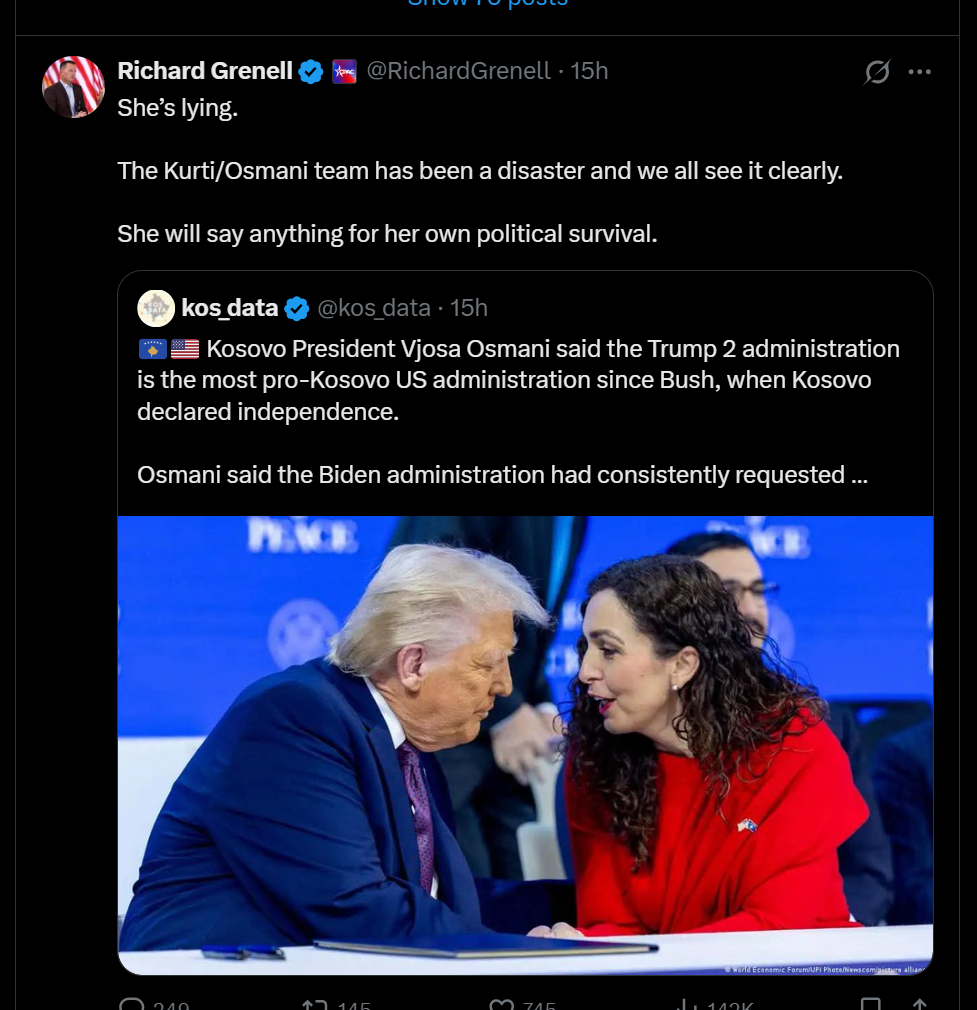
Richard Grenell accuses Vjosa Osmani of fabrication. The facts surrounding Trump’s own words suggest something else.
by the Editorial Board | 11 March 2026
Richard Grenell is not a man who speaks carelessly. When he posted this week that Kosovo President Vjosa Osmani is "lying" and "will say anything for her own political survival," he meant every word. He always does.
Which makes the question worth asking carefully: what, precisely, is she lying about?
Osmani's claim was specific. She told Syri TV that the Trump administration is the most pro-Kosovo U.S. administration since George W. Bush — the president who stood behind Kosovo's independence in 2008. She said Washington now supports Kosovo's sovereignty, territorial integrity, and NATO membership without demanding concessions in the Serbia dialogue. She described a substantive meeting with Secretary of State Marco Rubio in which they discussed recognition pathways and a concrete NATO accession plan. She contrasted all of this with the Biden years, when Washington repeatedly pressed Pristina to make concessions to Belgrade.
None of that is contested terrain. The Biden administration's pressure on Kosovo over the Serbia dialogue is documented. The shift in posture under Trump is real enough that Serbian President Aleksandar Vučić felt compelled to complain publicly that Osmani had appeared "like a star" at the Board of Peace — something, he said, he had not expected from the Trump administration. Vučić does not volunteer concessions he is not forced to make.
Then there is the Board of Peace itself. Trump personally invited Kosovo as a founding member. He praised Osmani for the great job she is doing in her country in a February speech. At the Washington signing ceremony, he addressed her warmly and directly. Fox News — the media outlet most reliably aligned with Trump's political base — described Osmani as a close ally of the U.S. president.
These are not details Osmani invented. They are the record of what happened.
Grenell's tweet does not dispute any of them. It offers no specific factual correction. It asserts a lie without identifying one. What it does instead is something different: it frames the entire Kurti-Osmani era as a catastrophe and dismisses anything Osmani says as political self-preservation. That may reflect genuine conviction. It certainly reflects a long personal history — the collapse of the 2020 Washington framework, the confrontation with Kurti that followed, grievances that have calcified over five years.
But conviction and evidence are not the same thing. And personal history is not a substitute for a factual rebuttal.
The deeper question for Kosovo's observers — the diplomats, analysts, and policymakers who read these signals for a living — is a structural one. Washington does not speak with a single voice. It never has. Allies carry personal agendas. Factions compete. A senior figure in the Trump orbit can hold views that diverge sharply from the actions of the president himself. That divergence does not automatically resolve in favor of the faction.
When a president personally extends an invitation, stands beside a foreign leader at his own initiative, and chooses — unprompted, in public — to praise her work, that is a signal of a particular kind. Trump is not a leader given to diplomatic courtesy he does not mean. He has no institutional script requiring him to say kind things about foreign heads of state. The praise was voluntary. The invitation was deliberate. The record it produced is the record Osmani cited.
Grenell called that record a lie.
The readers of this piece are sophisticated enough to weigh what that means.
