Lavrov spoke for Serbia at the UN, Belgrade said thank you, and Brussels kept the meeting going. The Kosovo problem survives because almost everyone except Kosovo has found a use for it.
By Dren Kryeziu | 28 September 2026
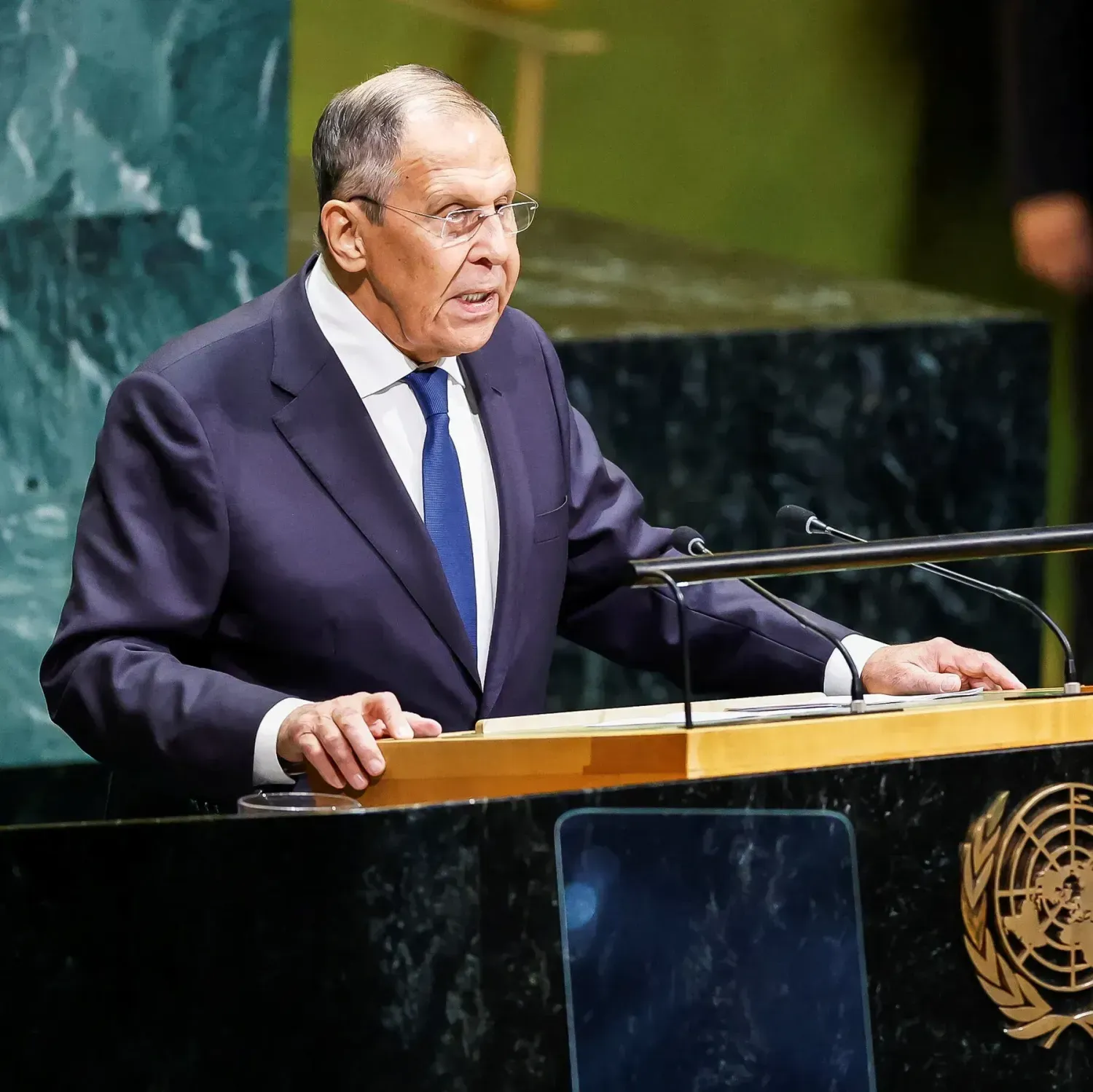
Sergey Lavrov spoke for Serbia at the UN General Assembly on Saturday. The European Union, he said, crudely ignores Resolution 1244 and forces Serbia to accept that it has lost Kosovo. In the same breath, the West forces Belgrade to sanction Russia in exchange for a prospect of membership that is illusory, as everyone already understands.
By Sunday morning Sputnik Srbija had found a man to be grateful. Dragoljub Bosnić, correspondent of the BRICS news agency, explained why the paragraph mattered. The Kosovo question, he said, has been completely sidelined and forgotten in world circles. For the West, the Kosovo and Republika Srpska story is practically over. Lavrov's sentence proves that Serbia still has friends.
He is right about one thing. As a dispute about Kosovo, the file is closed almost everywhere. It survives because it has become useful for other purposes, and the people it is useful to are not in Pristina. The question after Saturday is whose problem the Kosovo problem now is.
What Russia wants from Serbia is the government in Belgrade, and Kosovo is how it keeps it. Lavrov named the fear himself, in the same speech: the Russophobic regime in Kyiv. Moscow will not allow a second one, and the Kosovo file is the cheapest instrument it owns for preventing it. A veto in the Security Council and a paragraph in New York cost nothing, and what they buy is a Serbia that cannot move west without losing the veto, and therefore does not move.
Every town in the Balkans has a house with the top floor unfinished. Bare brick, rebar in the roof, the family living comfortably underneath. Nobody finishes it, because a finished house costs more than an unfinished one. Kosovo is the top floor of Aleksandar Vučić's house. With Kaja Kallas he can say his hands are tied by Russia. With his voters he can say the West wants Kosovo surrendered. With Moscow he offers the one guarantee it needs, that the floor will never be finished. Finishing it would mean membership, and membership means courts nobody can call, a public broadcaster nobody can instruct and a security service that answers to parliament. A decade of stalled chapters, four years of unaligned sanctions and the Cluster 3 refusal in July show what Belgrade has decided about that price.
The same line was already running at home. On Tuesday Kallas, after separate meetings with Vučić and Albin Kurti in New York, called the Ohrid agreement binding. By Saturday evening Sputnik had Stevica Deđanski's answer: Serbia never agreed to Ohrid, hold to the Brussels Agreement and Resolution 1244, do not fall for Western provocations, and wait, because cadres like Kallas and Tonino Picula will be cleared out in time. Lavrov did not have to send Belgrade a message. By Saturday evening Moscow and Belgrade were saying the same thing, and by Sunday Bosnić was thanking Russia for saying it. One line, two speakers.
Brussels is the third party, and here the picture is uglier than a neat symmetry. Brussels does want the file closed. It has also built a process in which nothing closes and nobody pays. Kallas says binding. Belgrade says it never agreed. The Union records both, keeps the dialogue in its sixteenth year, keeps certifying the government, and keeps waiting for Vučić to deliver the thing his whole position depends on never delivering. The one membership application in this story that the Union has not processed, nearly four years after it was lodged, is Kosovo's.
So ask the question the dialogue was built never to ask. Who loses if the Kosovo file closes tomorrow?
Russia loses the cheapest lever it has on Belgrade. Vučić loses the top floor, the excuse that works in both directions. Serbia's nationalists lose a grievance they have lived on for a generation. Brussels loses a process that has learned to survive its own failure.
Kosovo loses nothing. Kosovo gets to be a country instead of everybody else's instrument.
That is the fraud at the centre of the dialogue. The Kosovo problem is what the president of Serbia lives on, and the one party at the table that would gain from ending it is the one that keeps being told to wait.
