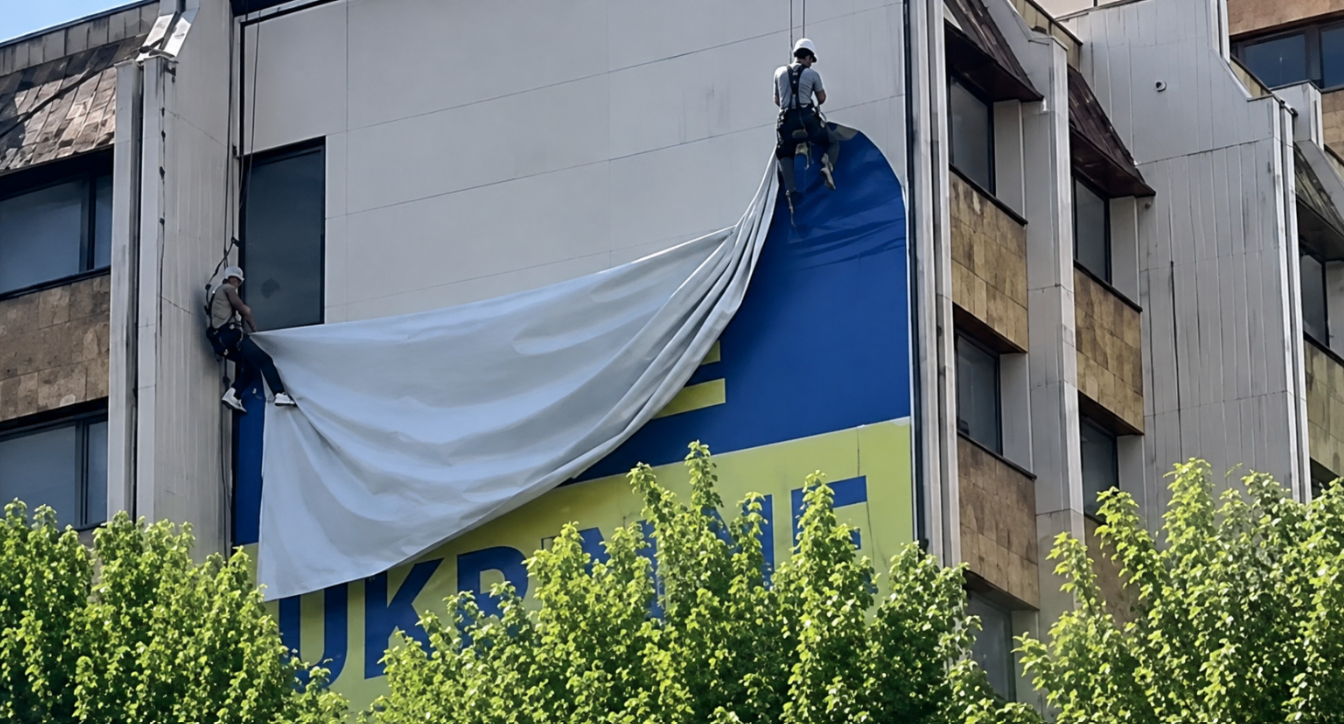
Prishtina has not withdrawn its solidarity with Ukraine. It has taken down a sentence that its addressee contradicted in Belgrade.
Editorial Board | 10 August 2026
Every city has one wall where it says things. Ours is thirteen floors of brown facade on Mother Teresa Boulevard, a hotel built in 1978 to prove Prishtina was a city of the world, and used in 1999 to prove the opposite. The men who came to erase this city drank in its lobby. Journalists who stayed there wrote down what they heard on the stairs. The hotel survived its guests, then stood mostly empty, a building with a memory and no work.
In the first weeks of the invasion of Ukraine, the city gave it work. A Ukrainian flag went up the facade, the length of floors that had seen what an army does to a people it has decided is not a people. No one in Prishtina needed the symbolism explained. A city that was told it did not exist hung the flag of a city being told the same. For four winters of the war the wall said one sentence: we know what is being done to you, because it was done to us.
On Sunday the municipality took the flag down, and the mayor posted the video himself.
The day before, in Belgrade, a journalist from Serbian state television had asked Ukraine's president whether Serbia could continue to count on Ukraine over Kosovo. He answered: "We respect the territorial integrity of our partners, we respect international law. Therefore, our position on the unilateral declaration of independence of Kosovo remains unchanged."
Weigh the question before the answer. What state television asked was whether Serbia can count on Ukraine: the vocabulary of allegiance, with the sides already drawn and Kosovo cast as an asset one capital holds for another. The frame had an exit. A president may answer that recognition belongs to law and to a state's own institutions, and is no neighbour's asset to count on. Ukraine's president answered inside the frame. Recognition is Ukraine's decision; reassurance to Belgrade was his choice. On the record of Serbian state television, Kosovo is now something Serbia counts on Ukraine for.
We are deeply disappointed by what he said. By answering a question about Kosovo with respect for Serbia's territorial integrity, Ukraine has chosen, in this case, to stand where Russia stands. That is why this declaration is particularly painful, and why we disagree profoundly.
So the flag came down, and it had to. Not in anger at a people; the people of Ukraine are under the bombs, and no one here has forgotten what that is. It came down because that wall does not carry decoration. It carries testimony, and testimony has one rule: it must be true. On Saturday, in Belgrade, inside Belgrade's own question, the sentence on our wall was contradicted by the man it was raised for. A city can forgive that. It cannot keep saying it.
We know how the empty facade will be read across the border, and we can bear the reading. We can even grant the harder objection, which is our own: a flag should outlast a press conference. But our support was never cloth. It moved in trucks, and it has not been recalled, and it will not be. Ukraine's freedom is a principle, and we will hold it the way this city holds its principles, at cost, without applause, for as long as it takes.
The wall is bare now. It is not silent. It is waiting for the sentence to be true again.