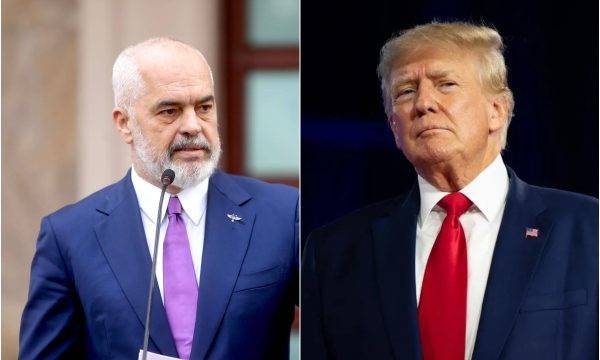
Trump’s invitation to Albania’s prime minister to join his Gaza “Board of Peace” is not about geography or capacity, but about loyalty, clarity, and control — a signal that Washington’s emerging approach to conflict management favors aligned, disciplined partners over traditional multilateral balance.
By Mark Gojcaj | 18 January 2026
When U.S. President Donald Trump invited Albanian Prime Minister Edi Rama to join the newly created Board of Peace on Gaza, the decision looked odd on its face. Albania has no border with Israel or Gaza, no troops on the ground, no financial firepower to rebuild a shattered enclave. Yet in Washington’s current logic, geography is secondary. Alignment is everything.
The Board of Peace — formally anchored in UN Security Council Resolution 2803 and unveiled last week — is Trump’s attempt to impose order on a postwar Gaza landscape while rewriting the rules of international crisis management. It is less a humanitarian committee than a power instrument: a layered structure designed to bypass paralysis, concentrate authority, and reward political clarity.
At the center sits Trump himself, flanked by a tight executive circle — Secretary of State Marco Rubio, Jared Kushner, Steve Witkoff, and Tony Blair — focused on strategy, capital, and political enforcement. Beneath them, a Gaza Executive Board handles operational details, drawing in regional actors with skin in the game. Around both is a broader Peace Council of invited world leaders, meant to confer legitimacy without diluting control.
Albania’s presence makes sense only when viewed through this lens.
Trump is not assembling a geographically representative body. He is assembling a coalition of dependables — states that will not equivocate on Hamas, will not complicate demilitarization, and will not insist on procedural multilateralism before action. In that respect, Tirana checks every box.
Under Rama, Albania has been one of Europe’s most predictably pro-American governments. A NATO member since 2009, it has consistently aligned with U.S. military and security priorities, often quietly and without hedging. On Gaza, its position has been unusually stark by European standards: Hamas framed not as a resistance movement but as a terrorist organization incompatible with any future Palestinian governance. Israel’s right to self-defense endorsed without rhetorical gymnastics. Two-state solution affirmed — but only after the removal of armed militants.
That clarity matters in this White House.
Rama’s public language — including his description of Hamas as “the Nazis of the new century” and his symbolic gestures toward Israeli hostages at the UN — placed Albania firmly inside Trump’s moral framing of the conflict. In an administration that equates ambiguity with obstruction, that posture is currency.
There is also a strategic optics play. Albania offers Trump something Egypt, Turkey, or Qatar cannot: support without regional baggage. As a Muslim-majority European NATO state, it allows the Board to project inclusivity while avoiding the rivalries, vetoes, and conditionalities that plague Middle Eastern diplomacy. Albania brings legitimacy without leverage — which, from Washington’s perspective, is precisely the point.
The pattern is consistent. Other early invitees — Argentina’s Javier Milei, Canada’s Mark Carney, Paraguay’s Santiago Peña — are not regional heavyweights either. They are ideologically aligned, politically reliable, and eager to convert proximity to U.S. power into diplomatic elevation. The Board of Peace is being built less like a peace conference and more like a trusted network.
For Rama, the invitation is a strategic win — but not without risk.
After more than a decade in power and a dominant fourth-term victory in 2025, he has made international stature a core pillar of his domestic narrative. EU accession remains slow and uncertain, while Washington has become Albania’s most responsive external partner. Being seen at Trump’s table reinforces Rama’s claim that Albania is no longer a peripheral state but a recognized political actor.
Yet association cuts both ways. The Board of Peace is controversial by design: its concentration of authority, its transactional funding model, and its implicit sidelining of traditional UN processes will draw resistance. If the Gaza project falters — or if the Board becomes a lightning rod for accusations of imposed governance — early members will not be neutral observers. They will be co-owners.
That reality underscores what this invitation actually represents. This is not a reward for Albania’s size or capacity. It is a test of discipline and loyalty in an emerging Trump doctrine of conflict management — one that prizes decisiveness over consensus and alignment over universality.
As the Board prepares to convene on the margins of the World Economic Forum in Davos, Rama’s presence signals something larger than Albania’s rise. It reflects a reordering of how Washington builds coalitions: smaller, tighter, more ideological, and less apologetic about exclusion.
For Albania, the door has opened. Where it leads will depend less on Gaza’s reconstruction than on how durable this new model of power proves to be.
About the Author
Mark Gojcaj writes from New York, where he examines the intersection of American conservatism and Southeast European political and security realities. He is a regular contributor to The Kosovo Dispatch’s transatlantic coverage, with a focus on U.S. foreign policy, NATO dynamics, and the Western Balkans.
