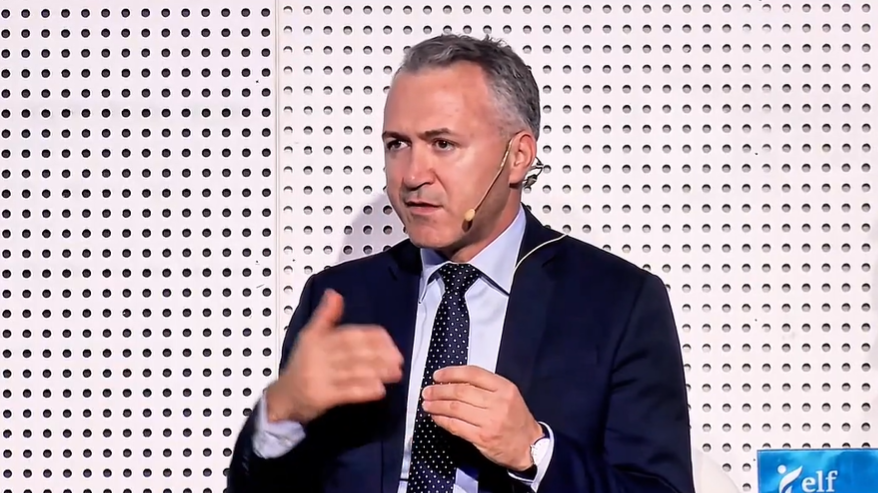
Kosovo's chief negotiator tells the Sofia forum that Kosovo should open its own chapters while the dialogue runs in parallel, and that Serbia's normalisation is Belgrade's Chapter 35 to fail. Kosovo Online's Serbian version cut Banjska.
Kosovo Dispatch | 20 September 2026
Kosovo's Chief Negotiator with the European Union, Jeton Zulfaj, told the "EU Meets the Balkans 5.0" forum in Sofia that Kosovo's accession path should run on its own chapters, with the Belgrade dialogue continuing in parallel, and that normalisation with Serbia "will happen once Serbia becomes normal."
Zulfaj was answering a moderator's question on what concrete progress is possible over the next year given that the agreements reached in the dialogue have not been implemented. His answer, posted in full on his own account, opened with Serbia's conduct. "We have a very difficult and aggressive neighbour who has not taken responsibility for the crimes it has committed and instead glorifies them. And as we saw, it worships now a person who has committed genocide."
He then set the timeline of the two processes side by side. The dialogue began in 2011. Serbia received candidate status in 2012, opened accession negotiations in 2013 and held its first intergovernmental conference in 2014, "without normalising relations." Since then, he said, some 39 agreements have been signed, the most recent in Brussels on 27 February 2023 with its annex in Ohrid. "And then a terrorist attack happened, an aggression by Serbia in Banjska. And then later, in our critical infrastructure in Ibër-Lepenc. So that is not the posture of a neighbour who wants normalisation, but who is very much committed to obstruction and an aggressive path."
The core of the answer was a proposal on sequencing. Serbia, Zulfaj noted, has 35 negotiating chapters, and normalisation with Kosovo is the subject of the last of them. "So they can be judged on what they do in rule of law, on justice and democracy and freedoms and protecting rights and all that. And they would get a positive evaluation if they did that. And only the last chapter would be the one that they would, as the posture they have, being aggressive, they would fail to complete." Kosovo, by contrast, has not opened negotiations and has no chapters. "Kosovo can also have its chapter while dialogue runs in parallel. We don't need Serbia to be the gate towards the EU. Because the EU is the gate towards the EU."
Membership, he added, is voluntary. "Those who don't want to join the EU, they shouldn't be forced to." He described what Kosovo wants from it in domestic terms: cleaner energy, cleaner water, better roads, "justice served in court."
He closed on why the two tracks should be separated. "It's not just Kosovo that they're trying to hold back. They're trying to hold back the entire region. Because they themselves are not interested to join. They want partnership with multiple centres, whereas we are very much transatlantic. And I think this is part of the problem on normalisation, because they are not living in the reality."
The forum is an annual gathering organised by the European Liberal Forum with the ALDE Party and the Atlantic Club of Bulgaria, hosted by MEP Ilhan Kyuchyuk.
The remarks come three days after Michael Young, the nominee for US ambassador to Serbia, told the Senate Foreign Relations Committee in his prepared statement of 17 September that he would encourage Serbia to promote security, stability and prosperity across the Western Balkans, "including through normalization of relations with Kosovo."
Belgrade-based Kosovo Online carried the remarks in Serbian on Sunday afternoon under the headline that Kosovo does not need Serbia as its gate. Its text, sourced to RTK live, followed Zulfaj's answer closely but omitted the passage naming Banjska as a terrorist attack and an act of Serbian aggression and Ibër-Lepenc as an attack on critical infrastructure, along with the sentence "the EU is the gate towards the EU."
